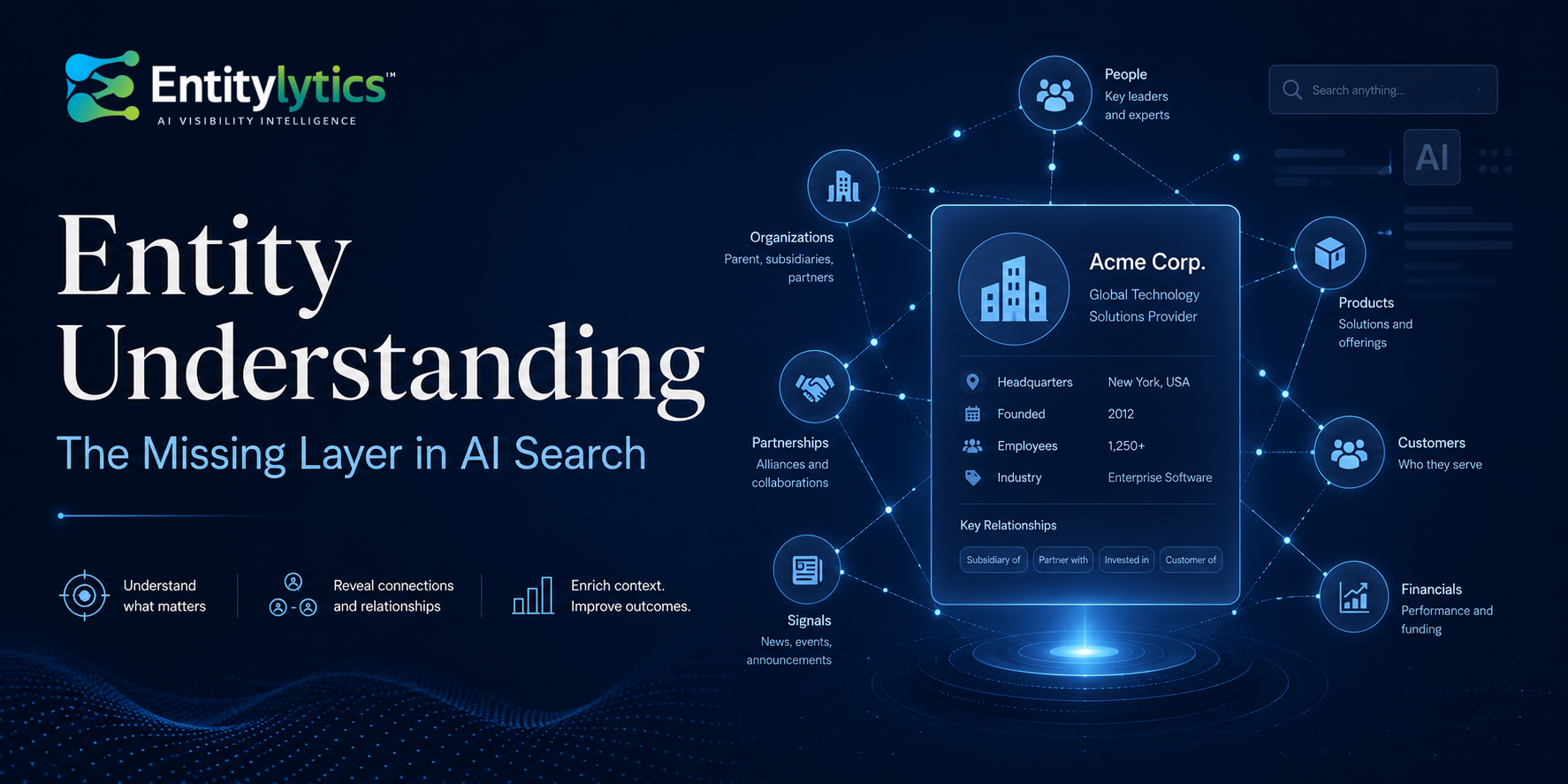
For years, businesses have focused heavily on search visibility: rankings, keywords, backlinks, traffic, and local map placement. Those still matter. But AI search introduces another requirement that many businesses have not fully accounted for yet: entity understanding.
In traditional search, a business could often win by creating optimized pages around the right keywords. In AI search, the system has to do more than find a page. It has to interpret the business behind the page.
That means AI needs to understand your business as a real-world entity. It needs to know what you offer, who you help, where you operate, what makes you credible, and which situations make you a good recommendation.
It is whether AI systems can confidently understand, classify, trust, and recommend your business in the right context.
What is entity understanding?
Entity understanding is the ability of a search engine or AI system to recognize your business as a distinct, meaningful entity and understand the relationships around it.
This includes your business name, services, products, categories, locations, leadership, expertise, customer types, industry relevance, supporting evidence, and reputation signals.
Basic understanding
Can AI identify the business, its website, its location, and its primary category without confusion?
Service understanding
Can AI clearly explain what the business offers and when those offerings are relevant?
Audience understanding
Can AI identify who the business serves, such as homeowners, agencies, contractors, patients, buyers, or local customers?
Trust understanding
Can AI find enough public evidence to justify recommending the business with confidence?
The gap between SEO visibility and AI understanding
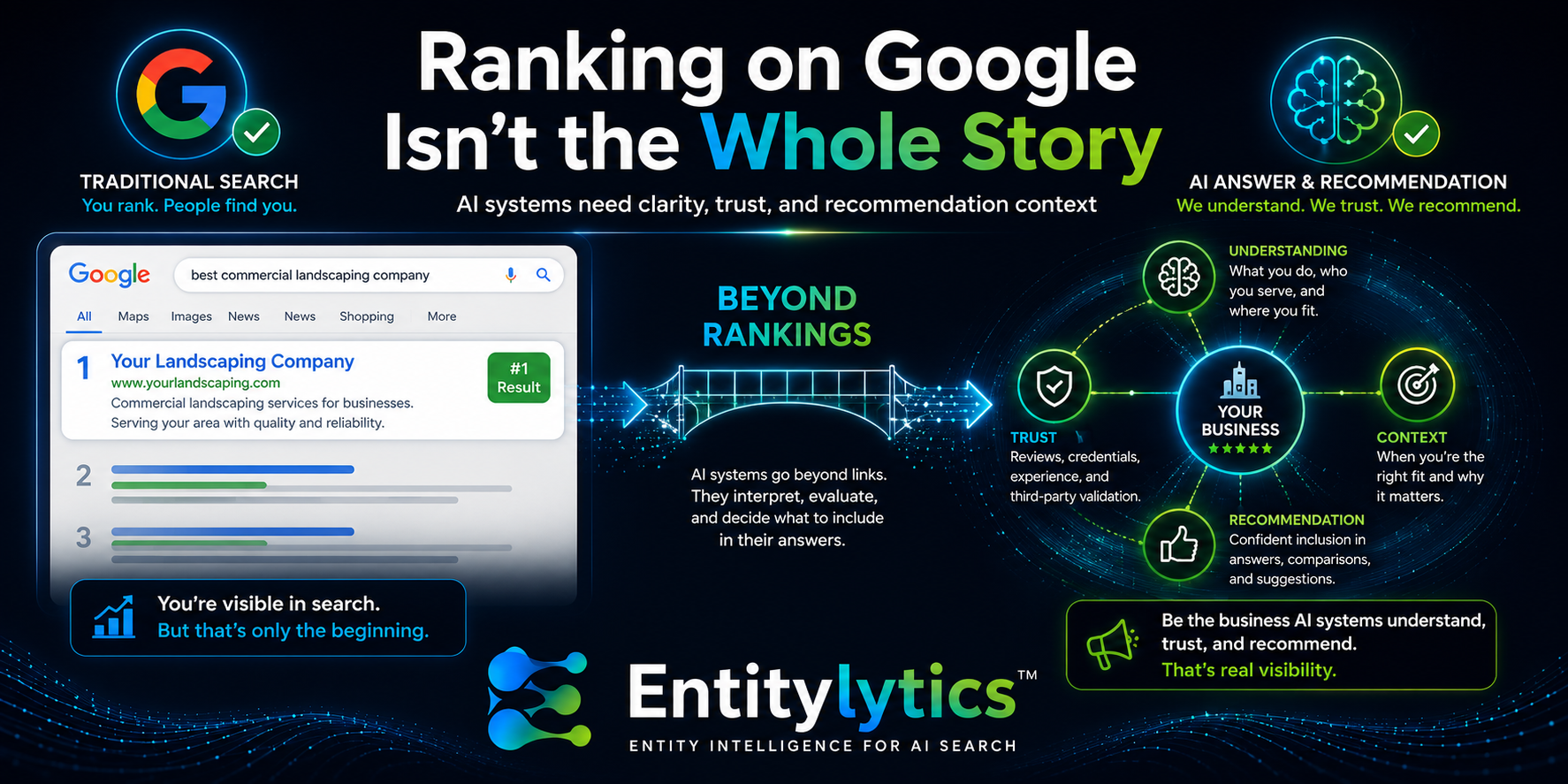
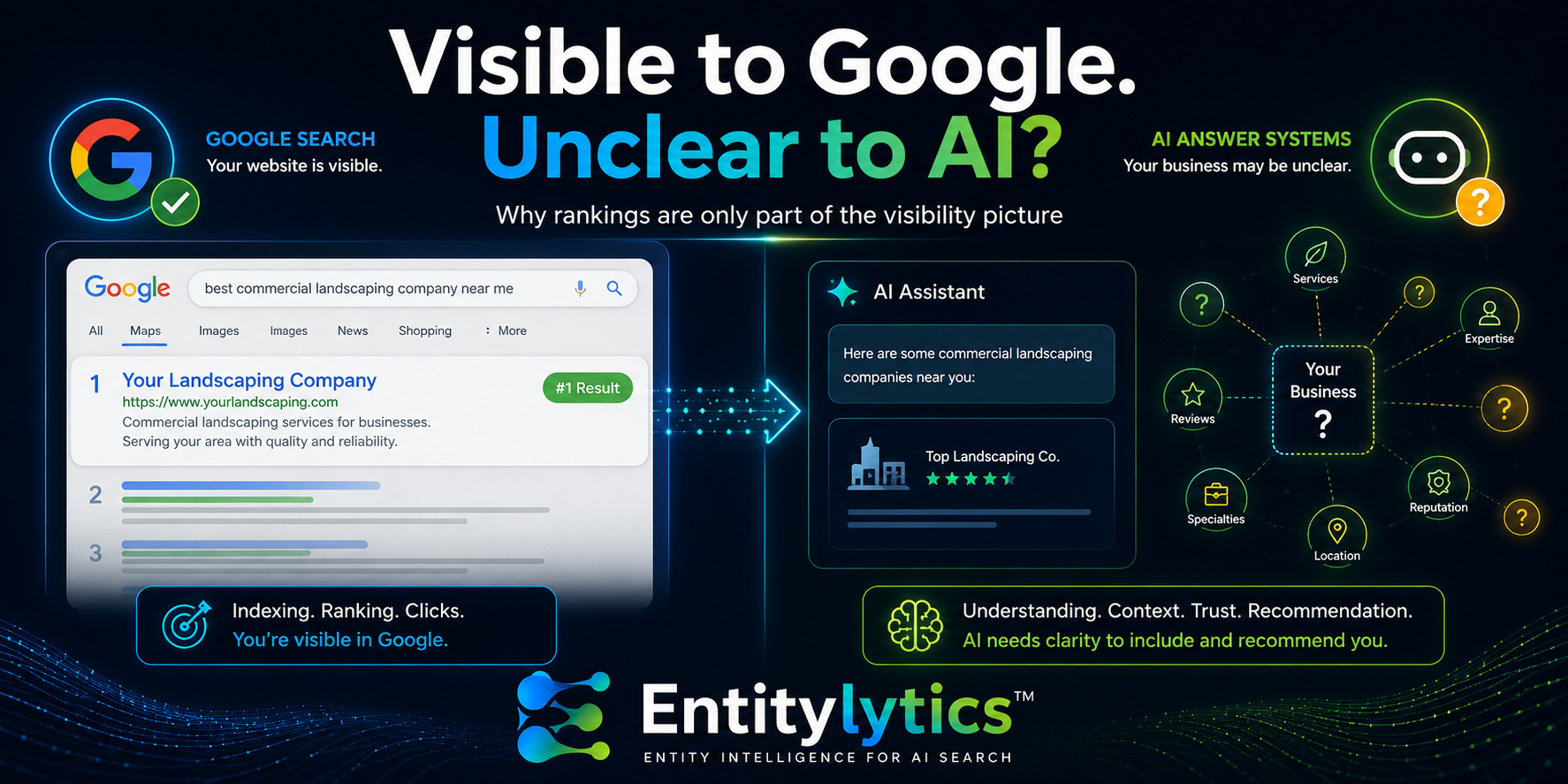
A website can be optimized for search engines and still be unclear to AI systems. That is one of the biggest shifts business owners need to understand.
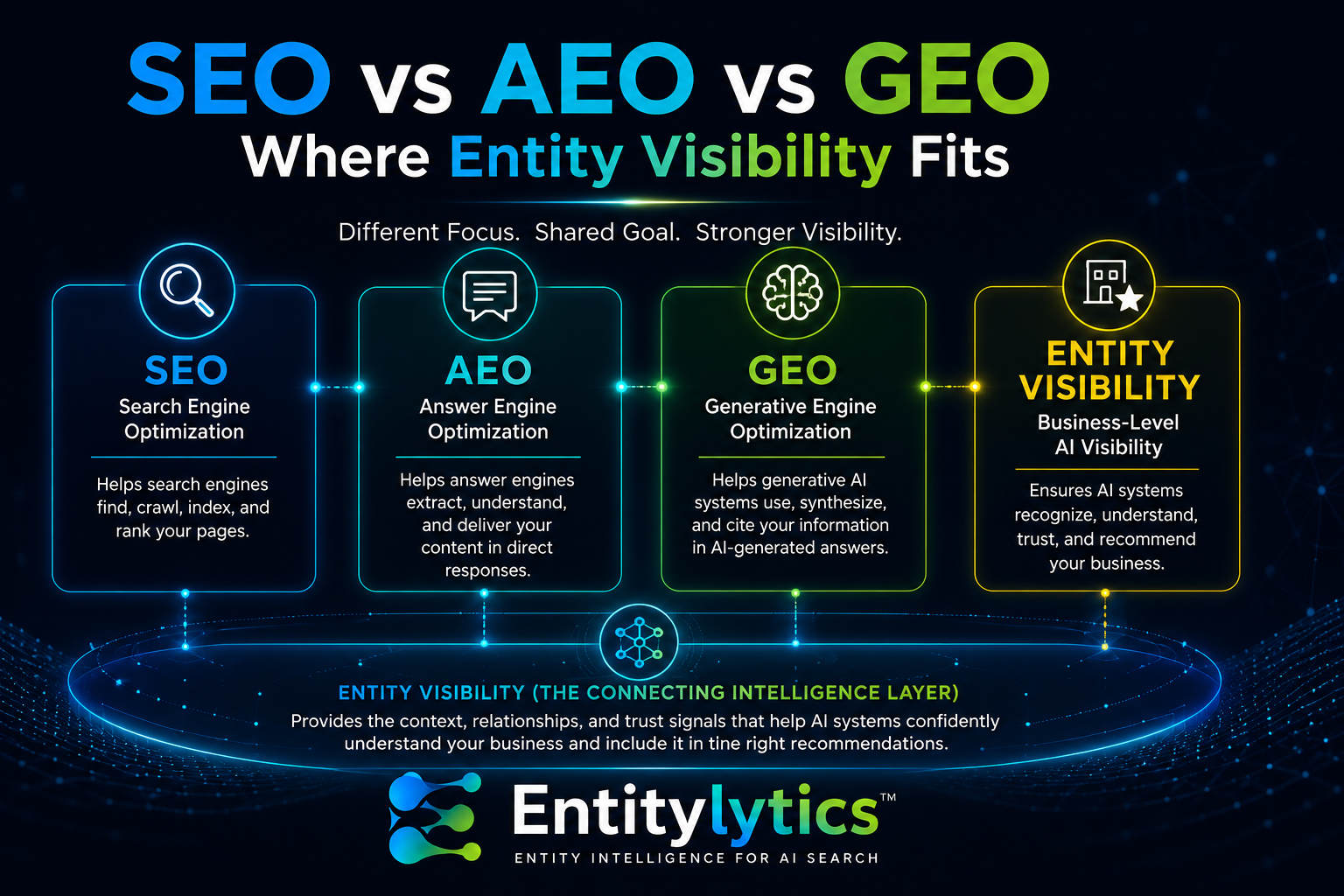
SEO often focuses on whether pages can rank for specific queries. Entity understanding focuses on whether AI can accurately interpret the business behind those pages.
Traditional SEO asks:
- Can this page rank?
- Does it target the right keyword?
- Is the page optimized?
- Can search engines crawl it?
- Does it attract traffic?
AI understanding asks:
- What is this business?
- What does it actually do?
- Who should it be recommended to?
- Why should it be trusted?
- What evidence supports the recommendation?
This is why some businesses may appear visible in search results but still struggle to show up clearly in AI-generated answers, summaries, and recommendations.
Is your business clear to AI systems?
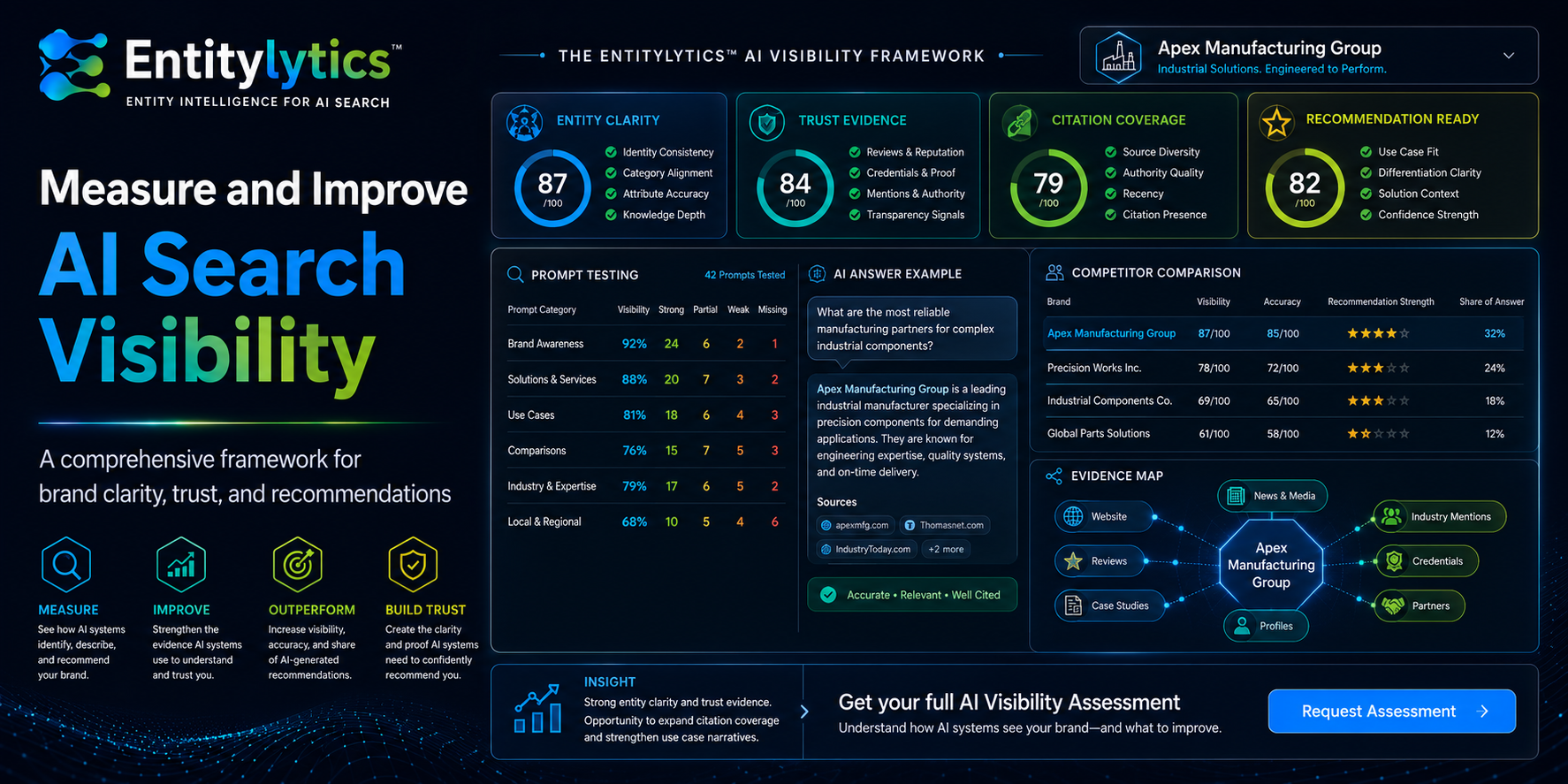
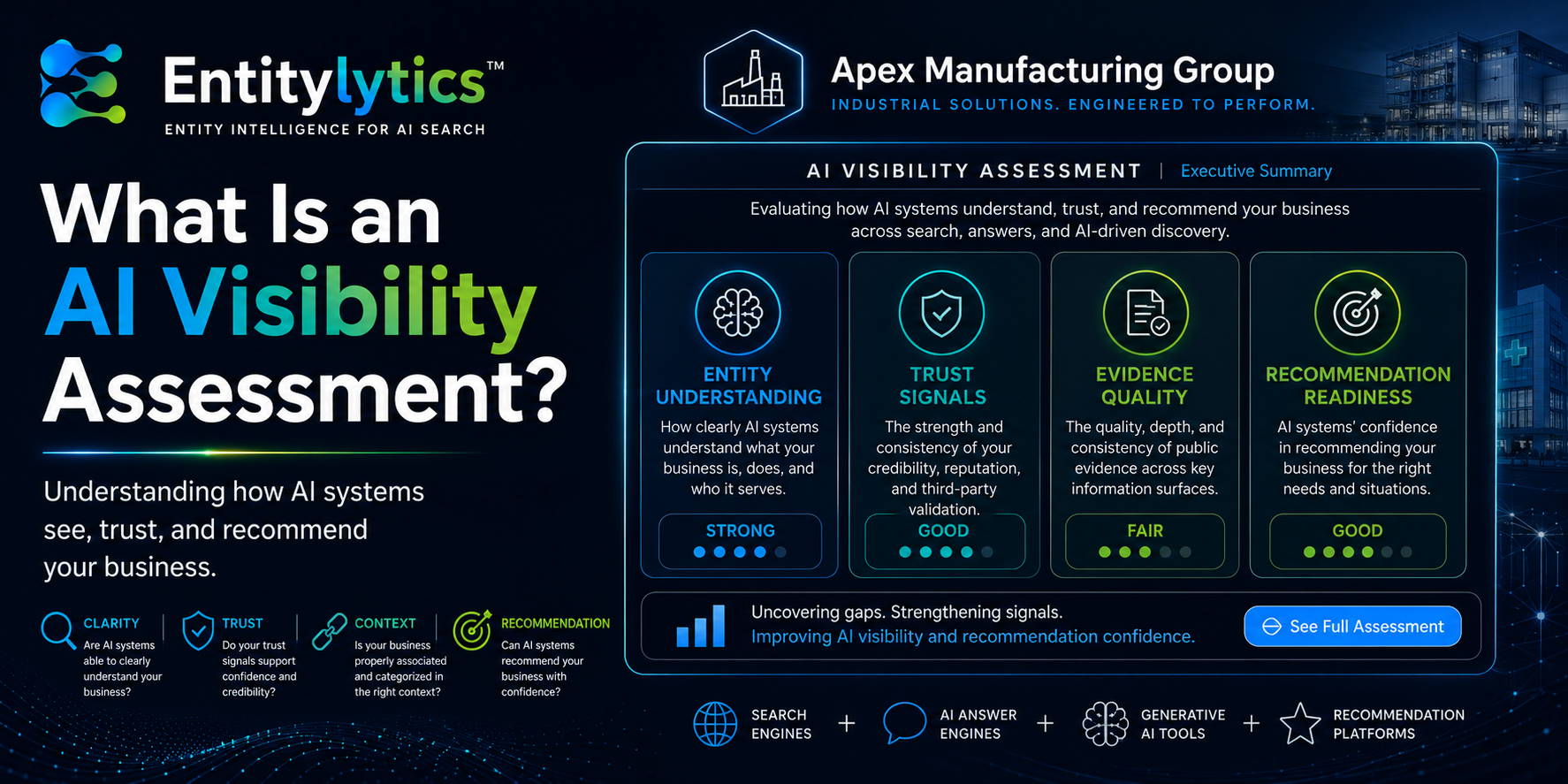
Entitylytics™ evaluates how AI systems may understand, trust, associate, and recommend your business based on the evidence available across your website and public digital presence.
What AI systems need to understand about your business
AI systems work best when the evidence around your business is clear, consistent, and connected. The more ambiguous your public information is, the harder it becomes for AI to confidently place your business into the right recommendation context.
What your business is
Your business category, primary purpose, location, ownership, and identity should be easy to identify across your website and public profiles.
What your business does
Services and products should be described clearly, not just listed as keywords. AI needs context, not just labels.
Who your business serves
AI should be able to understand the audiences, customer types, industries, or use cases where your business is relevant.
Where your business operates
Local, regional, national, or online service coverage should be stated clearly and supported by consistent evidence.
Why your business should be trusted
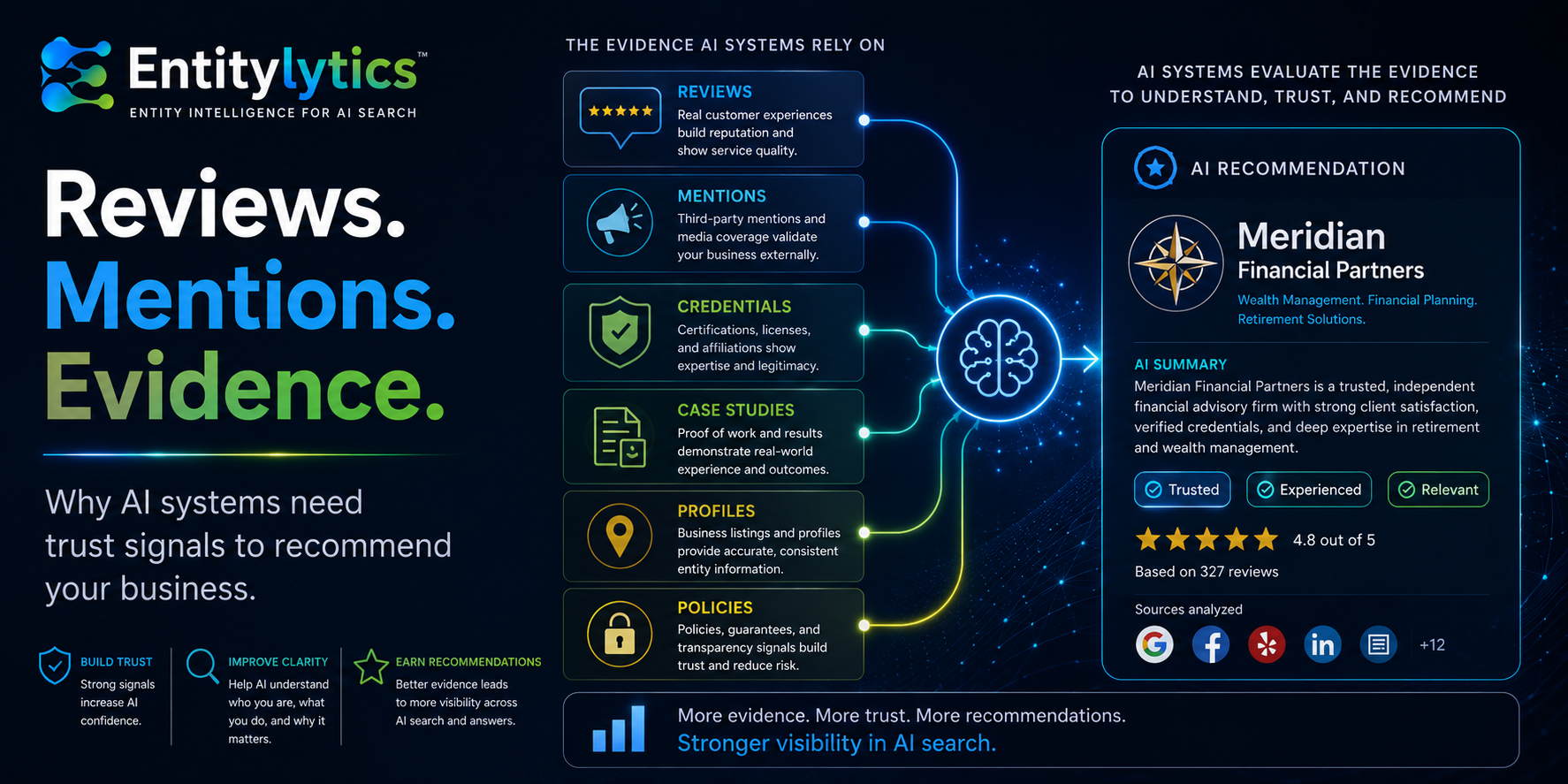
Reviews, credentials, experience, case examples, policies, team information, third-party mentions, and other trust signals help support recommendation confidence.
When your business should be recommended
AI needs to understand the scenarios where your business is a good fit, and just as importantly, where it may not be the right fit.
Common gaps that weaken entity understanding
Many businesses have strong real-world experience but weak AI-readable evidence. The business may be legitimate, experienced, and highly recommended by customers, yet still be difficult for AI systems to interpret with confidence.
Generic service pages
Pages that say what you offer but do not explain who it is for, when it is needed, or why your business is qualified.
Inconsistent business details
Conflicting names, categories, addresses, service areas, or descriptions across directories, profiles, and website pages.
Missing trust signals
Limited evidence of experience, credentials, team expertise, reviews, policies, case studies, or external validation.
Unclear recommendation fit
AI may understand what you sell but not understand when your business should be recommended over another option.
The issue is that the value is not expressed in a way AI systems can confidently understand, connect, and use.
How businesses can improve entity understanding
Improving entity understanding does not mean chasing every new AI trend. It means strengthening the public evidence layer around your business so AI systems have a clearer picture to work with.
Clarify your business identity
Make sure your business name, category, location, service area, and primary offering are consistently presented across your website and major public profiles.
Explain services in context
Do not rely only on short service labels. Explain what each service is, who it helps, common use cases, limitations, and why your business is qualified to provide it.
Strengthen trust evidence
Add visible proof points such as experience, reviews, certifications, team background, case examples, project photos, warranties, policies, media mentions, and industry-specific credibility signals.
Connect related pages and topics
AI systems benefit from clear relationships. Your website should connect services, products, locations, FAQs, about information, reviews, and educational content in a way that reinforces what your business is known for.
Define recommendation scenarios
Help AI understand when your business is a strong fit. This may include specific customer problems, service situations, product use cases, industries served, geographic needs, or buyer priorities.
Why this matters now
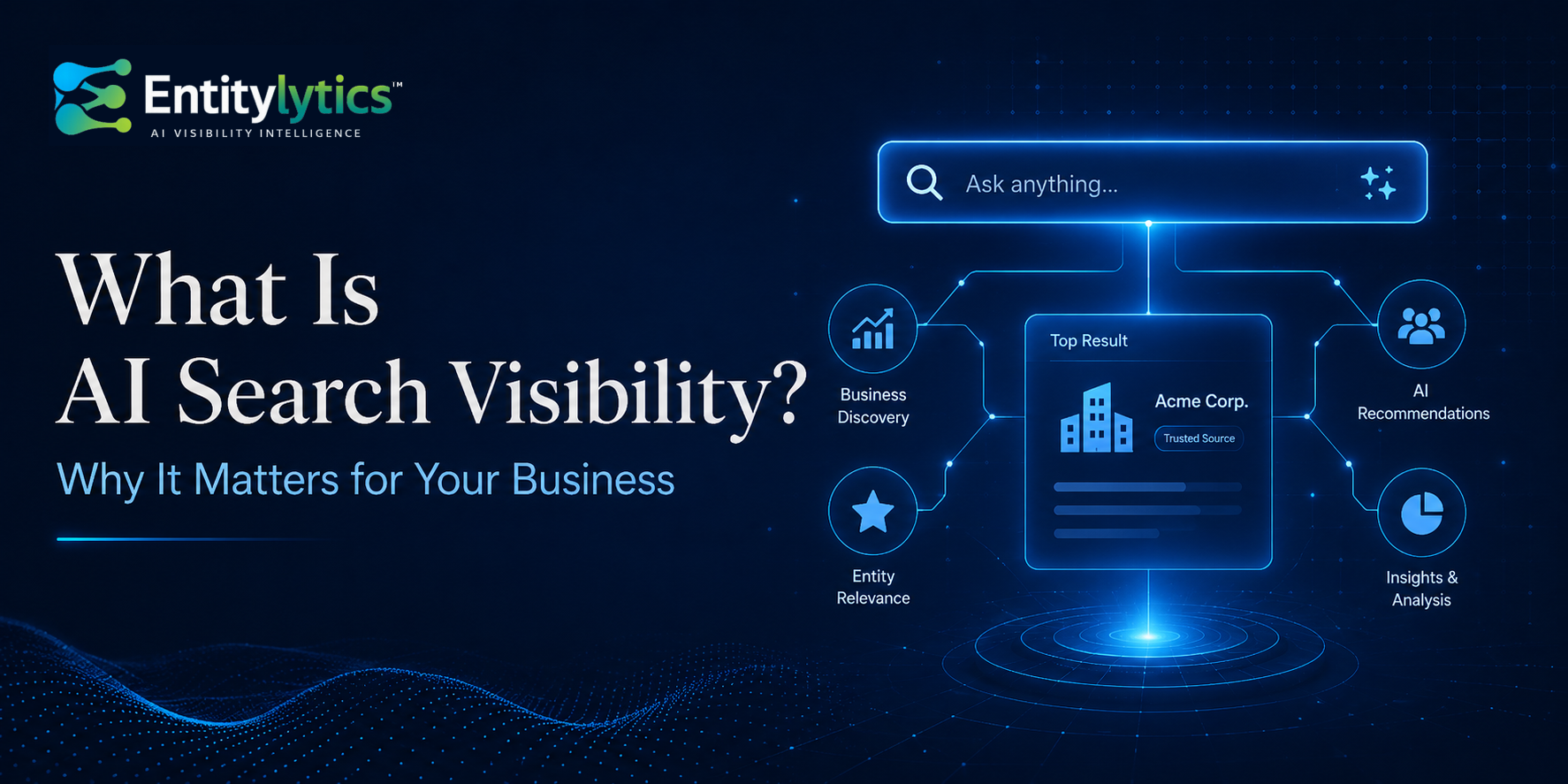
AI search is not only about being indexed. It is about being interpreted. When someone asks an AI system for the best provider, the right local business, a recommended product, or a trusted expert, the system needs enough evidence to make a confident connection.
Businesses that invest in entity understanding are not just optimizing for today’s search results. They are building a clearer evidence profile for the next generation of search, discovery, and recommendation systems.
They will be the ones AI systems can understand clearly, trust appropriately, and recommend confidently.
FAQ: Entity understanding and AI search
Is entity understanding the same as SEO?
No. SEO focuses heavily on visibility, rankings, technical performance, and content optimization. Entity understanding focuses on whether AI systems can accurately understand the business itself, including what it does, who it serves, and why it should be trusted.
Can my business rank well on Google but still be unclear to AI?
Yes. A business may have pages that rank but still lack the structured, consistent, and contextual evidence AI systems need to confidently explain or recommend it.
Does this only matter for large brands?
No. Local businesses, service companies, eCommerce stores, medical practices, contractors, agencies, and niche providers can all benefit from clearer entity understanding.
What kinds of evidence help AI understand a business?
Helpful evidence may include clear service pages, consistent business details, reviews, FAQs, about information, credentials, case studies, product details, local signals, third-party mentions, and structured relationships between related pages.
How does Entitylytics evaluate this?
Entitylytics™ reviews how clearly a business is understood, trusted, associated, and positioned for AI-driven recommendation scenarios. The goal is to identify evidence gaps, ambiguity, trust limitations, and opportunities to improve AI comprehension.
Find out how AI systems may understand your business
An Entitylytics™ Assessment can help identify where your business is clear, where AI systems may hesitate, and what evidence gaps may be limiting recommendation confidence.
Entitylytics™ helps businesses evaluate AI visibility, entity understanding, trust signals, and recommendation readiness.