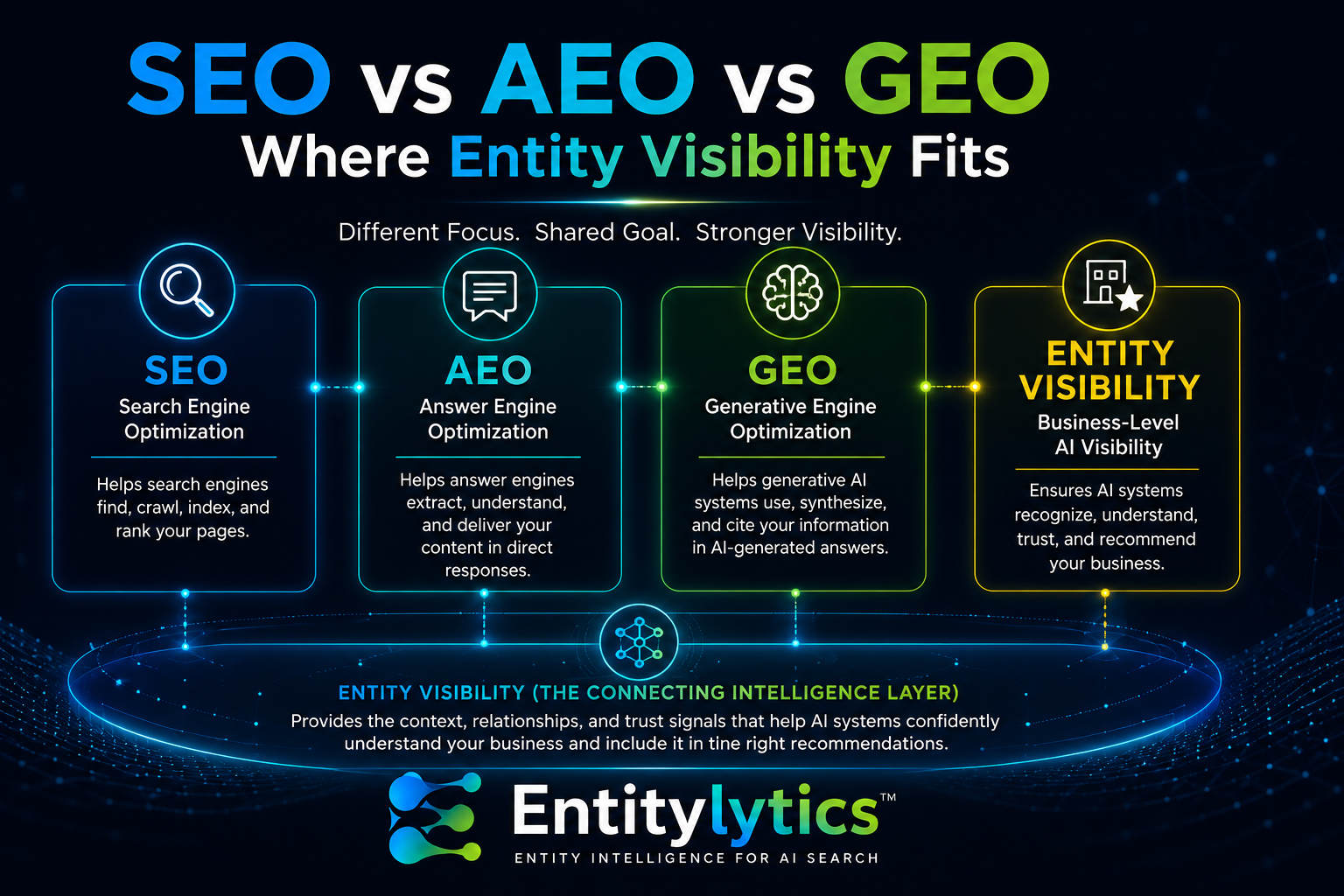
As AI changes search behavior, businesses are hearing more terms like SEO, AEO, GEO, AI visibility, and entity visibility. The challenge is that these terms are often used interchangeably, even though they describe different layers of visibility.
For business owners, this can get confusing fast. One person says you need SEO. Another says you need AEO. Another talks about GEO. Then someone else says AI search visibility is the new priority.
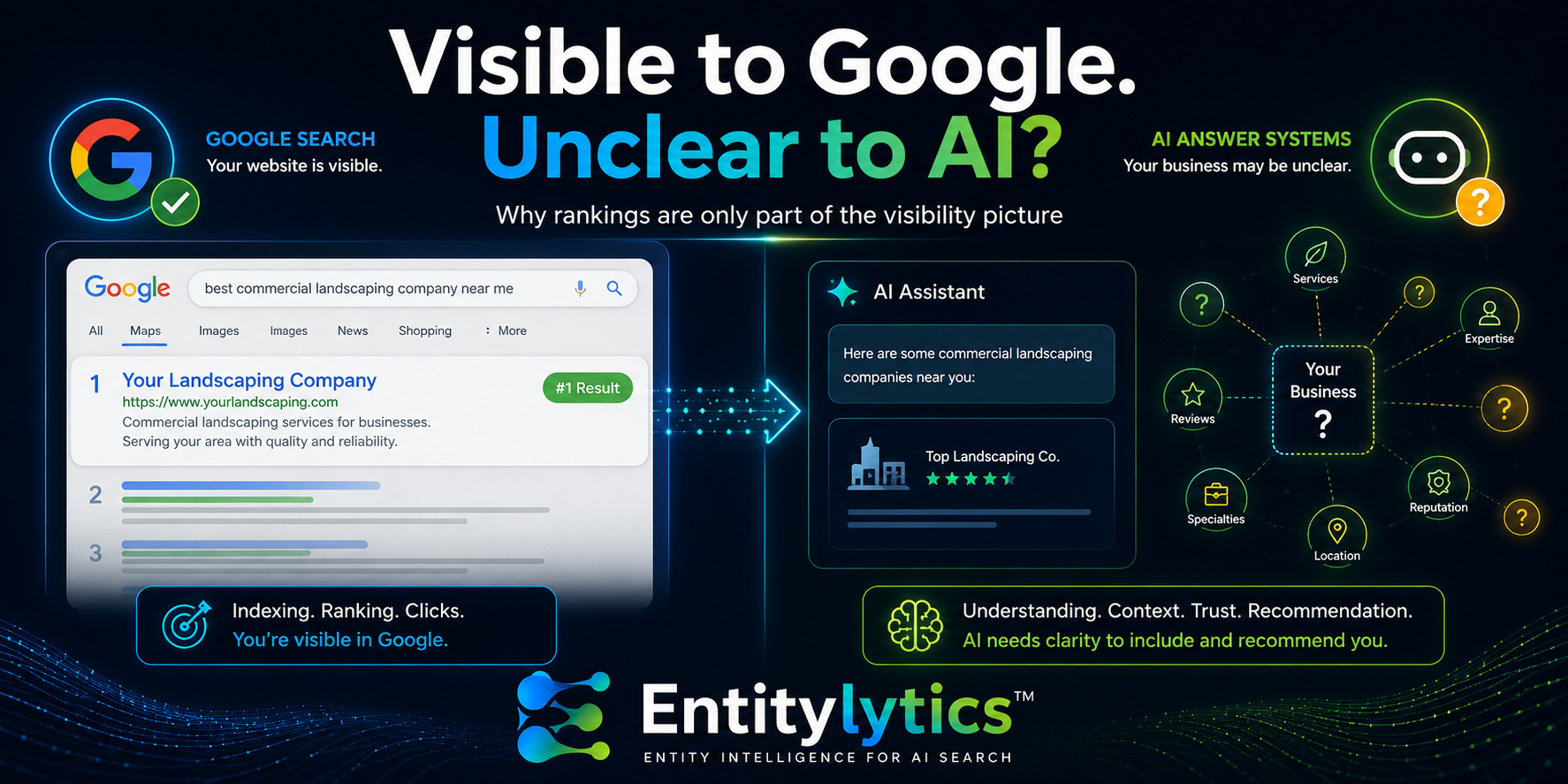
The truth is simpler: these are not competing ideas. They are connected layers. SEO still matters. Answer visibility matters. Generative AI visibility matters. But underneath all of it, AI systems need to understand the business entity clearly enough to use it in the right context.
The broader question is, “Can search and AI systems understand, trust, and recommend our business?”
What is SEO?
SEO, or search engine optimization, is the practice of improving a website so search engines can crawl, understand, index, rank, and display its pages for relevant searches.
SEO traditionally focuses on page-level visibility. It asks whether your website has the technical foundation, content relevance, authority, internal structure, and user experience needed to perform in search results.
Technical visibility
Can search engines crawl, index, render, and understand the pages on your website?
Keyword relevance
Do your pages align with the terms, topics, and intent customers use when searching?
Content quality
Does the content provide useful, relevant, and complete information for the searcher?
Authority and trust
Does the website have signals that support credibility, reputation, and search performance?
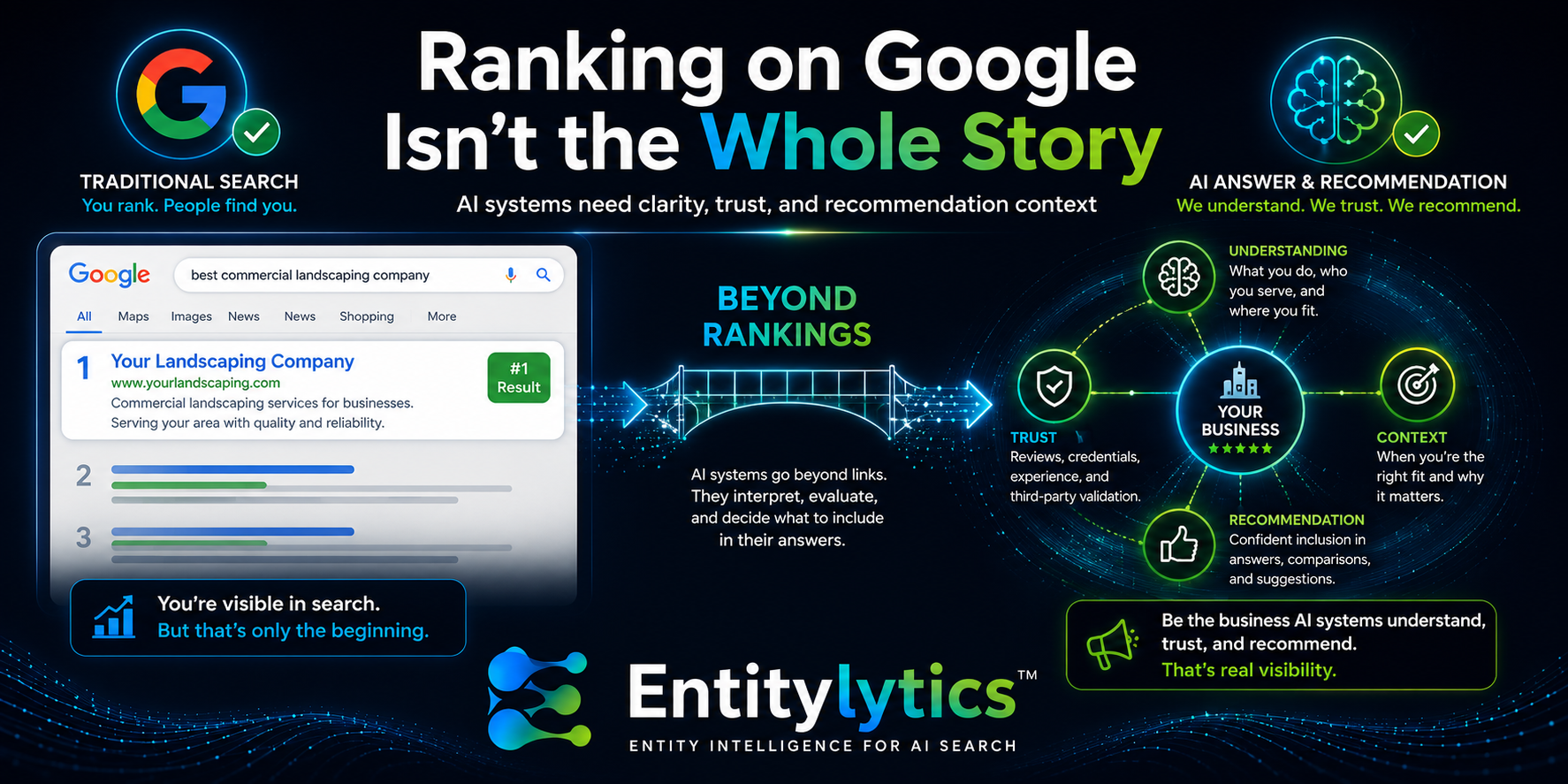
SEO remains important because AI systems still depend on accessible, understandable, and trustworthy web content. But SEO alone does not guarantee that AI systems will confidently explain or recommend your business.
What is AEO?
AEO, or answer engine optimization, focuses on making your content easier for answer-based systems to extract, summarize, and present in response to specific questions.
AEO became more important as search engines started showing featured snippets, direct answers, knowledge panels, People Also Ask results, voice assistant responses, and other answer-driven experiences.
SEO often asks:
- Can this page rank for the query?
- Is the page optimized for the topic?
- Does the content satisfy search intent?
- Can users click through to the site?
AEO often asks:
- Can this content directly answer the question?
- Is the answer clear and extractable?
- Does the page support concise summaries?
- Can the system trust the answer enough to present it?
AEO is especially useful for FAQ content, how-to content, definitions, comparison pages, service explanations, and other content that maps clearly to customer questions.
Is your business clear beyond traditional SEO?
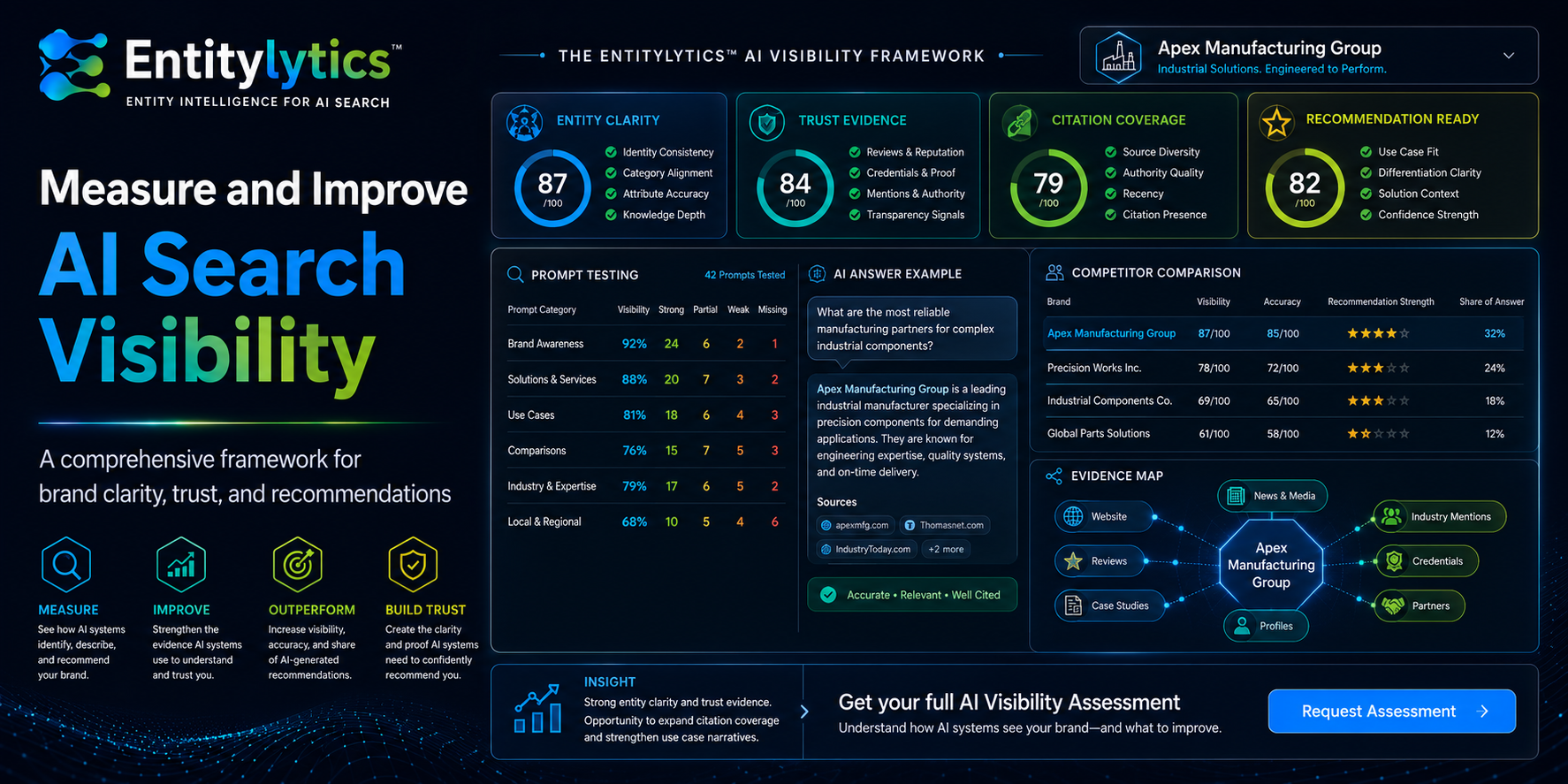
Entitylytics™ evaluates how AI systems may understand, trust, associate, and recommend your business based on the evidence available across your website and public digital presence.
What is GEO?
GEO, or generative engine optimization, is focused on visibility within generative AI systems that produce synthesized answers rather than traditional ranked search results.
In a generative AI experience, the system may combine information from multiple sources, summarize a topic, compare options, explain tradeoffs, or suggest next steps. The user may never see a traditional list of search results in the same way.
Synthesized answers
GEO considers how information may be used inside AI-generated explanations, comparisons, and summaries.
Source inclusion
The question is whether your business, website, or supporting evidence may be included as part of the generated response.
Contextual relevance
GEO depends on whether your content fits the user’s intent, question, scenario, and decision context.
Evidence quality
Generative systems need information that is clear, consistent, specific, and credible enough to use.
GEO is broader than AEO because the AI system may not simply pull one direct answer. It may synthesize a recommendation or explanation from a range of evidence.
What is entity visibility?
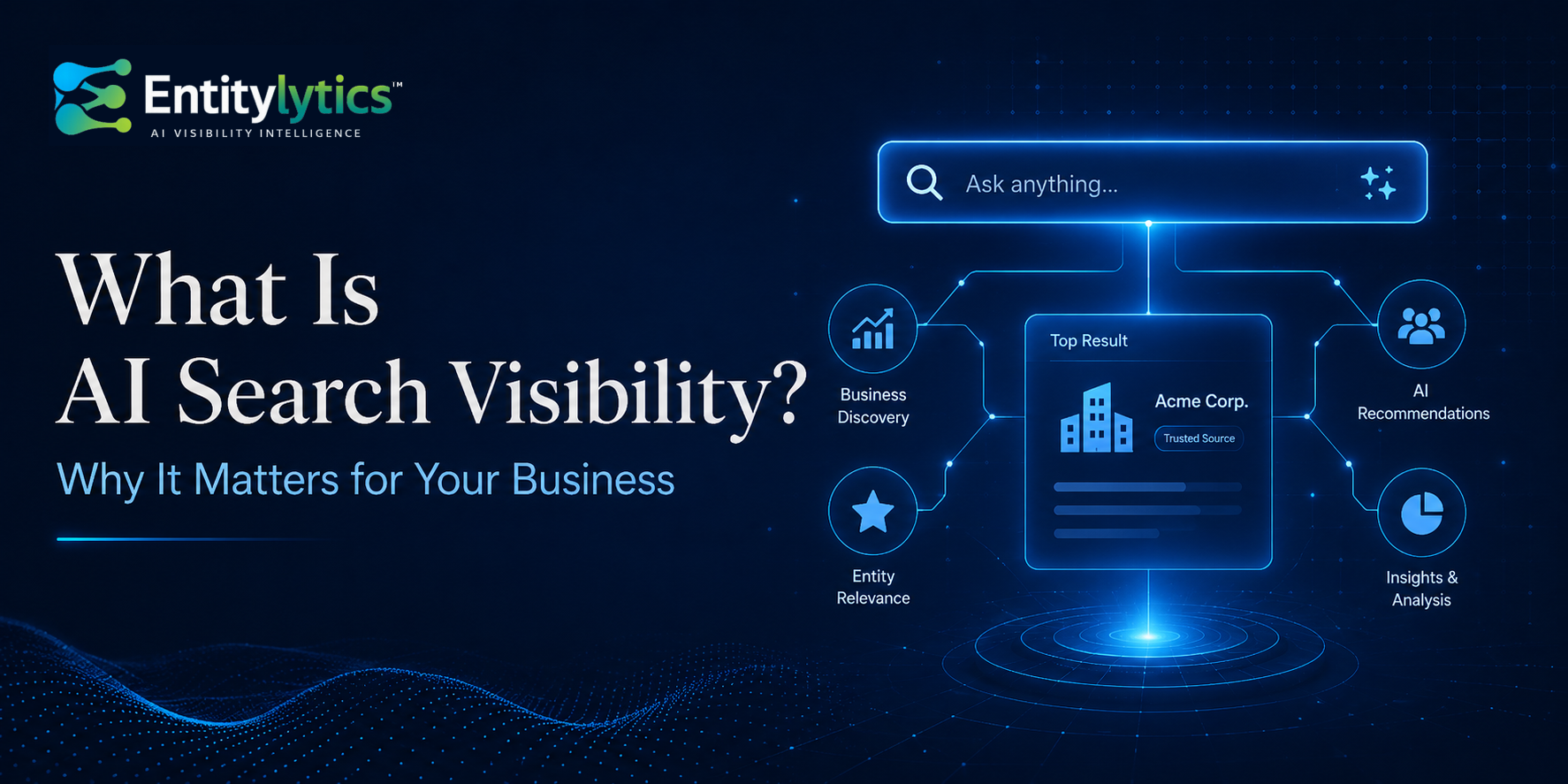
Entity visibility focuses on whether search engines and AI systems can recognize, understand, connect, trust, and recommend your business as a distinct real-world entity.
This is the layer that ties SEO, AEO, and GEO together. A business is not just a collection of web pages. It has a name, location, services, products, customers, reputation, expertise, ownership, relationships, and public evidence.
Entity recognition
Can systems identify your business as a distinct entity and separate it from similarly named businesses, brands, products, or locations?
Entity understanding
Can systems understand what the business does, who it serves, where it operates, and what it should be associated with?
Trust confidence
Can systems find enough evidence to treat the business as credible, legitimate, and appropriate for the recommendation context?
Recommendation readiness
Can systems understand when your business should be recommended, why it fits, and what boundaries should apply?
It is not only about whether one page ranks or one answer appears. It is about whether your business is understood clearly enough to be included in AI-driven discovery and recommendation pathways.
How SEO, AEO, GEO, and entity visibility work together
These disciplines overlap, but each one has a different center of gravity. The strongest approach does not treat them as separate silos. It uses them together.
SEO builds the foundation
Strong technical SEO and content structure help search and AI systems access, crawl, and interpret your website.
AEO improves answer clarity
Clear answers, FAQs, definitions, and decision-support content help systems respond to specific questions.
GEO supports AI synthesis
Well-structured, credible, and contextual content increases the chance that generative systems can use your evidence accurately.
Entity visibility connects the business
Consistent identity, trust signals, and recommendation context help AI systems understand the business behind the content.
A business can have SEO activity without strong entity clarity. It can answer common questions without strong recommendation readiness. It can publish content without building enough trust evidence. That is why the entity layer matters.
What should businesses prioritize?
The right priority depends on the current condition of the business’s website, public presence, trust evidence, and content structure. But for most businesses, the strongest path starts with clarity.
Start with a clear business identity
Make sure your name, category, location, service area, and core offering are consistent across your website and major public profiles.
Make service and product pages more specific
AI systems need context. Describe what you offer, who it is for, when it is useful, what problems it solves, and why your business is qualified to provide it.
Build visible trust evidence
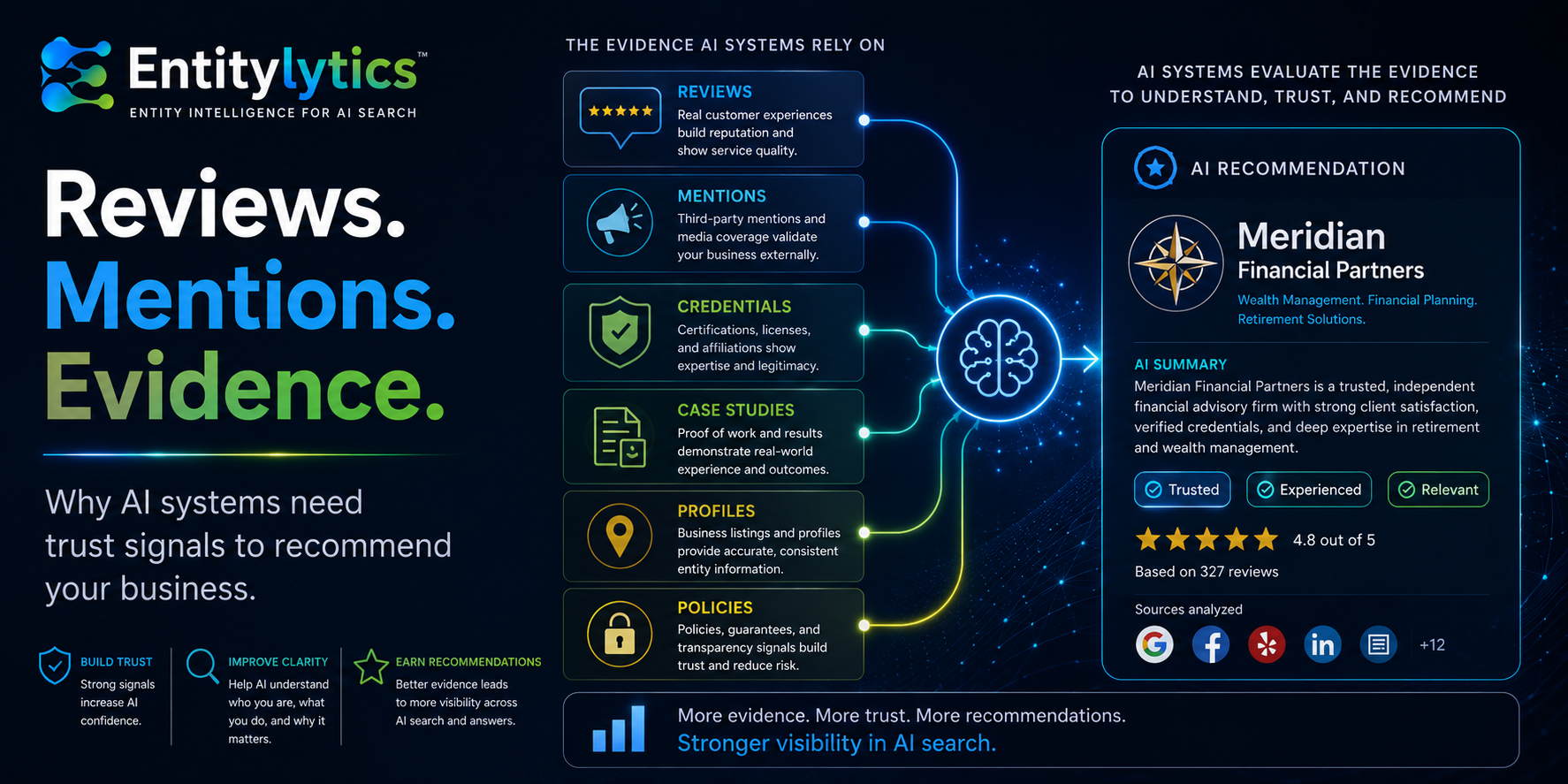
Reviews, credentials, team background, case examples, policies, guarantees, experience, and third-party mentions can all help support recommendation confidence.
Create answer-friendly content
Use FAQs, educational pages, comparison content, and practical explanations to answer the questions customers are likely to ask AI systems.
Connect your evidence
Internal links, structured page relationships, consistent descriptions, and clear topical organization help AI systems connect the dots.
SEO helps you get found. AEO helps you answer. GEO helps you appear in generated responses. Entity visibility helps AI systems understand why your business belongs in the conversation.
The future is not SEO versus AI visibility
It is tempting to frame AI search as the replacement for SEO, but that misses the point. The future is not about abandoning SEO. It is about expanding the way businesses think about visibility.
Search engines, answer engines, and generative AI systems all need evidence. They need accessible information, clear context, trusted sources, and consistent business identity. The businesses that adapt will be the ones that make their value easier for machines to understand and easier for customers to trust.
That is where entity visibility becomes so important. It gives businesses a way to think beyond pages and keywords and toward a more complete question: how clearly does the digital world explain who we are, what we do, and why we should be recommended?
FAQ: SEO, AEO, GEO, and entity visibility
Is SEO still important for AI search?
Yes. SEO still matters because AI systems depend on accessible, crawlable, useful, and trustworthy content. The difference is that SEO is now part of a broader visibility strategy that also includes entity understanding, trust signals, and recommendation readiness.
Is AEO the same as GEO?
Not exactly. AEO focuses on making content easier for answer engines to use in direct responses. GEO focuses more broadly on how generative AI systems may synthesize, summarize, compare, and recommend information.
Where does entity visibility fit?
Entity visibility sits at the business level. It focuses on whether AI systems can recognize and understand the business itself, not just individual pages or answers.
Can a business have good SEO but weak entity visibility?
Yes. A business may rank for some keywords but still have unclear business identity, weak trust evidence, inconsistent public information, or limited recommendation context.
How does Entitylytics evaluate these issues?
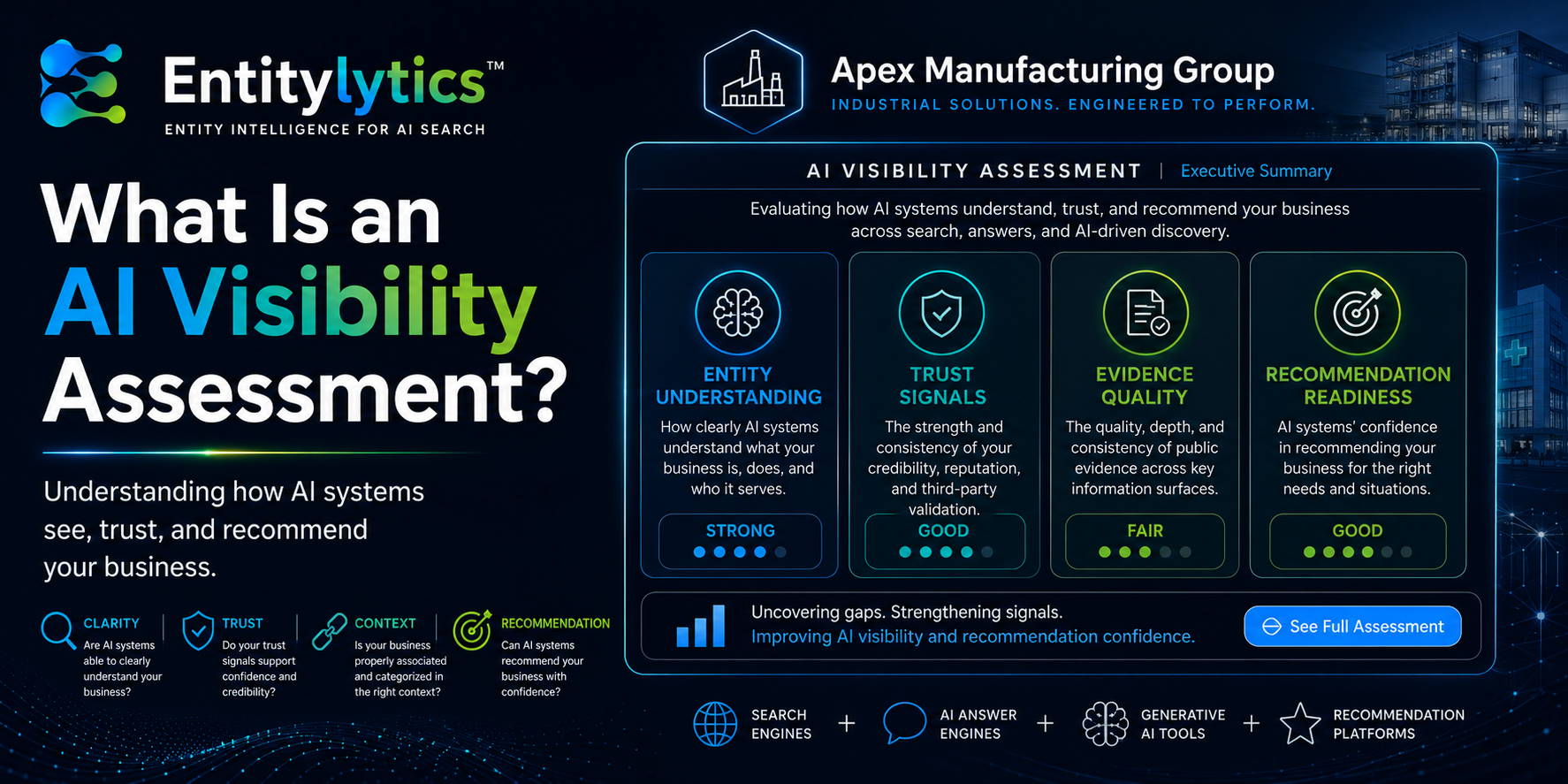
Entitylytics™ evaluates how AI systems may understand, trust, associate, and recommend a business. The assessment identifies evidence gaps, ambiguity, trust limitations, and opportunities to improve AI visibility and recommendation confidence.
Find out how clearly AI systems understand your business
An Entitylytics™ Assessment can help identify whether your business has the entity clarity, trust evidence, and recommendation context needed for the next generation of search.
Entitylytics™ helps businesses evaluate AI visibility, entity understanding, trust signals, and recommendation readiness.