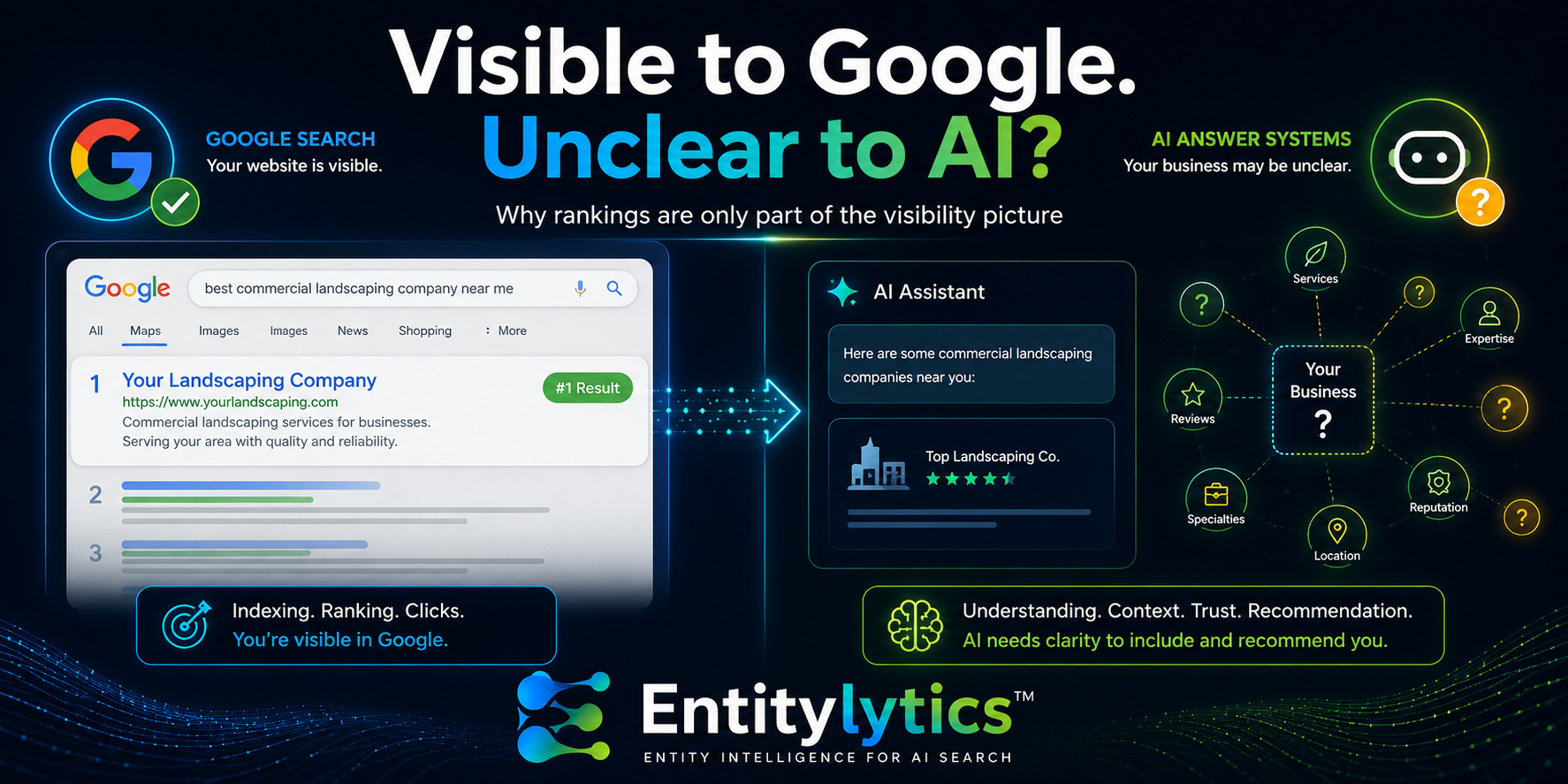
Many business owners assume that if their website is visible in Google, AI systems should understand their business clearly. That is not always the case.
Google visibility usually means your pages can be crawled, indexed, and shown for certain searches. That is valuable. But AI systems often need to do more than locate a page. They need to interpret the business, understand the context, evaluate supporting evidence, and decide whether the business belongs in an answer or recommendation.
This is where some websites run into trouble. They may have search visibility, organic traffic, and even decent rankings, but the business itself may still be unclear to AI systems.
The bigger question is whether AI systems can understand what your business does, who it serves, where it fits, and why it should be trusted.
Why a visible website can still be unclear to AI
Traditional search engines and AI systems overlap, but they do not evaluate information in exactly the same way. A page may be good enough to rank for a keyword, but not complete enough to help AI confidently understand the business entity behind it.
AI systems often look for patterns, relationships, supporting evidence, and context. They are not only trying to match words. They are trying to understand meaning.
Pages may rank individually
A service page can rank for a term without clearly explaining the full business, its expertise, or its recommendation fit.
Business context may be thin
AI may find your website but struggle to understand your positioning, service boundaries, audience, or real-world credibility.
Evidence may be disconnected
Reviews, service pages, about information, location details, and trust signals may exist but not reinforce each other clearly.
AI may see ambiguity
Similar names, broad categories, vague descriptions, or inconsistent profiles can make the business harder to interpret.
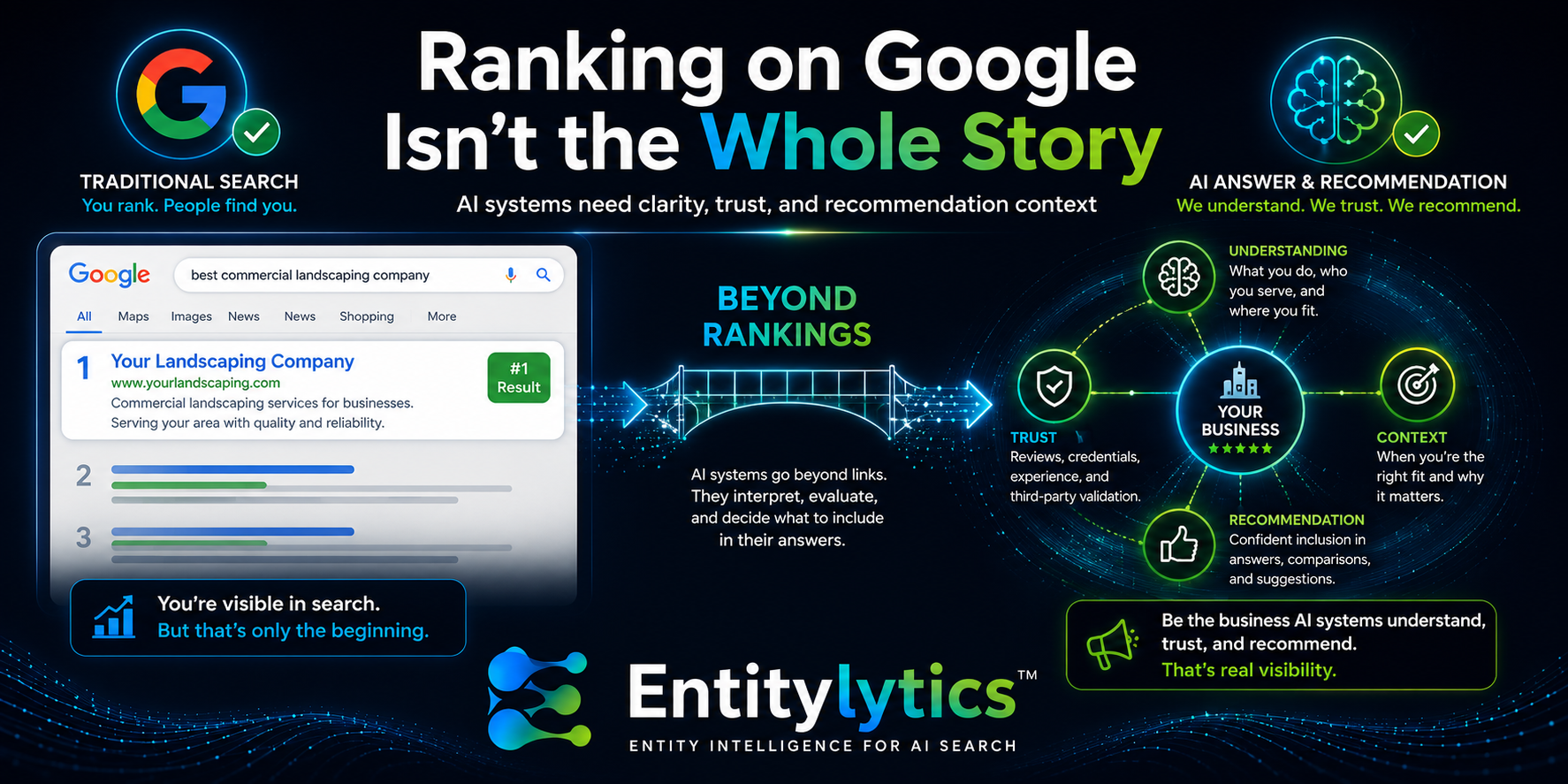
Google visibility and AI clarity are related, but different
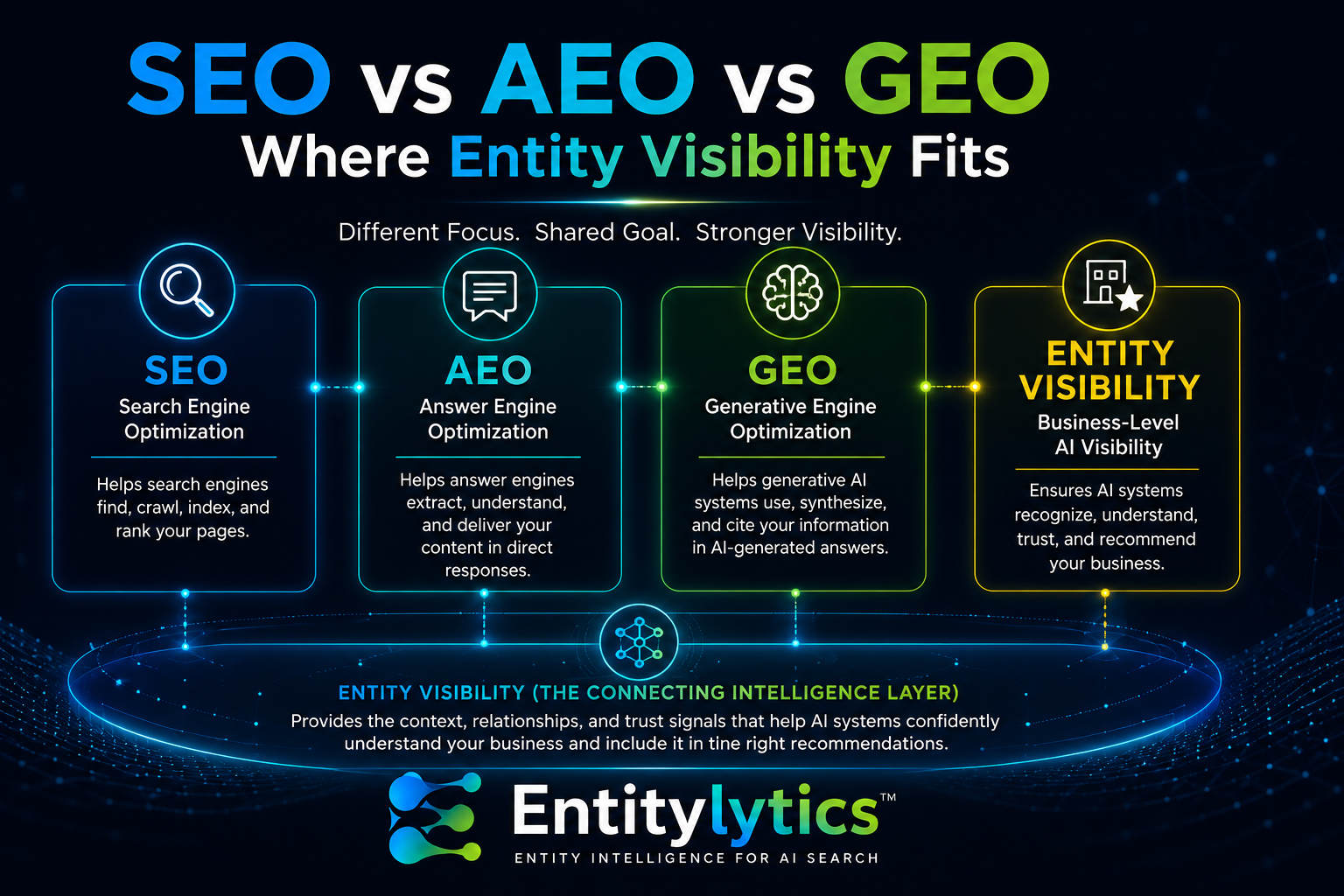
SEO helps search engines find, crawl, index, and rank your pages. AI clarity helps systems understand the business behind those pages well enough to summarize, compare, or recommend it.
Both matter. But a business can be stronger in one area than the other.
Google visibility often asks:
- Can the page be crawled and indexed?
- Does it target a relevant keyword?
- Does the page satisfy search intent?
- Does it have enough authority to rank?
- Can users find and click the result?
AI clarity often asks:
- What business is this?
- What does it actually do?
- Who does it serve?
- Why should it be trusted?
- When should it be recommended?
This is why AI visibility cannot be reduced to rankings alone. Rankings can help create discoverability, but AI systems still need enough context and evidence to understand how the business fits into a user’s question.
Can AI systems clearly understand your business?
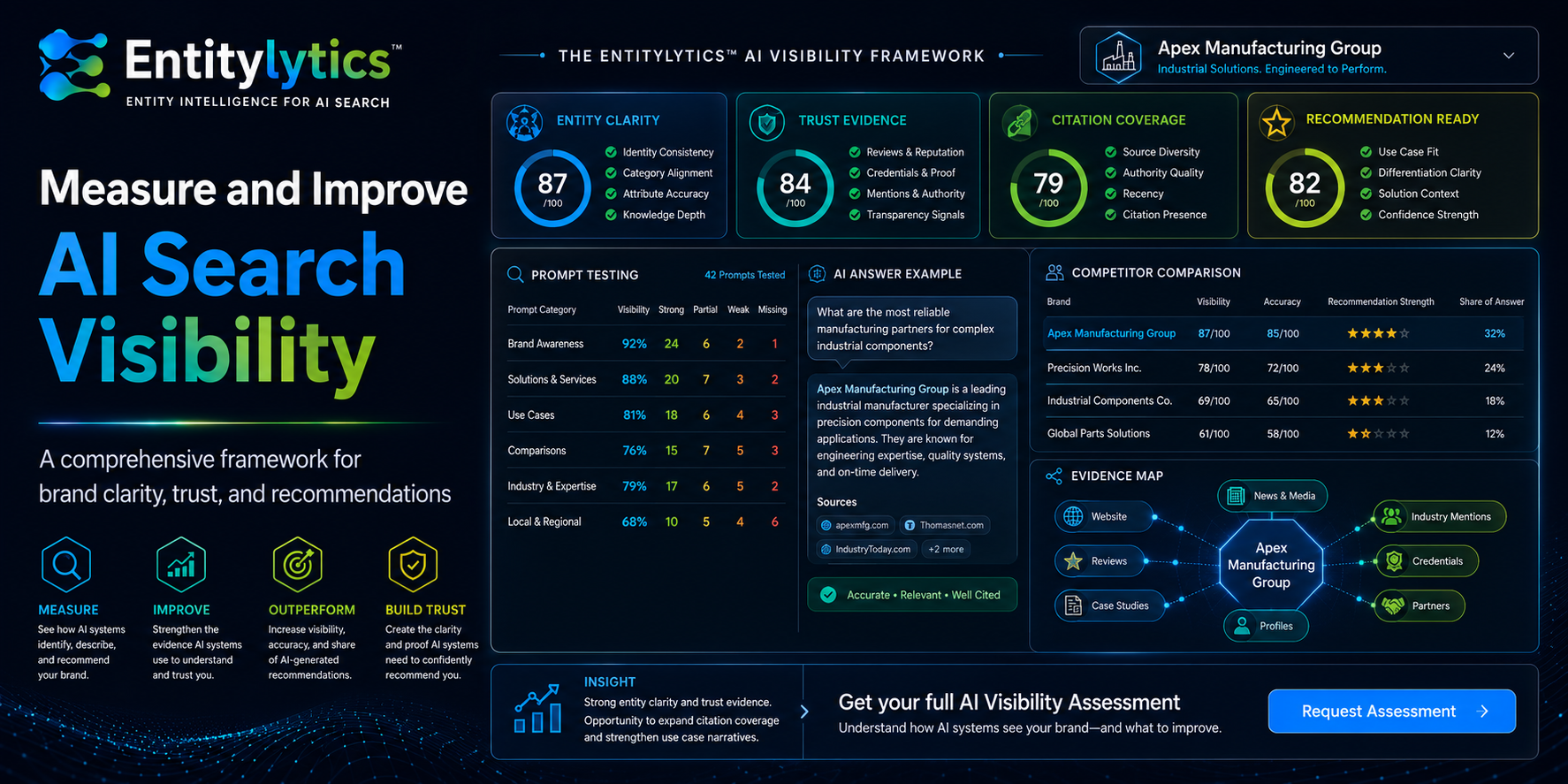
Entitylytics™ evaluates how AI systems may understand, trust, associate, and recommend your business based on the evidence available across your website and public digital presence.
Common reasons AI may not understand your business clearly
When a website is visible to Google but unclear to AI, the cause is often not one single problem. It is usually a collection of clarity, consistency, and evidence gaps.
Your pages are keyword-focused but not context-rich
A page may use the right terms but fail to explain the service, customer problem, use case, process, qualifications, or decision criteria in enough detail.
Your business category is too broad or unclear
AI may struggle when a business is described with broad labels but lacks specific explanations of its actual services, audience, or specialization.
Your trust signals are weak or hard to find
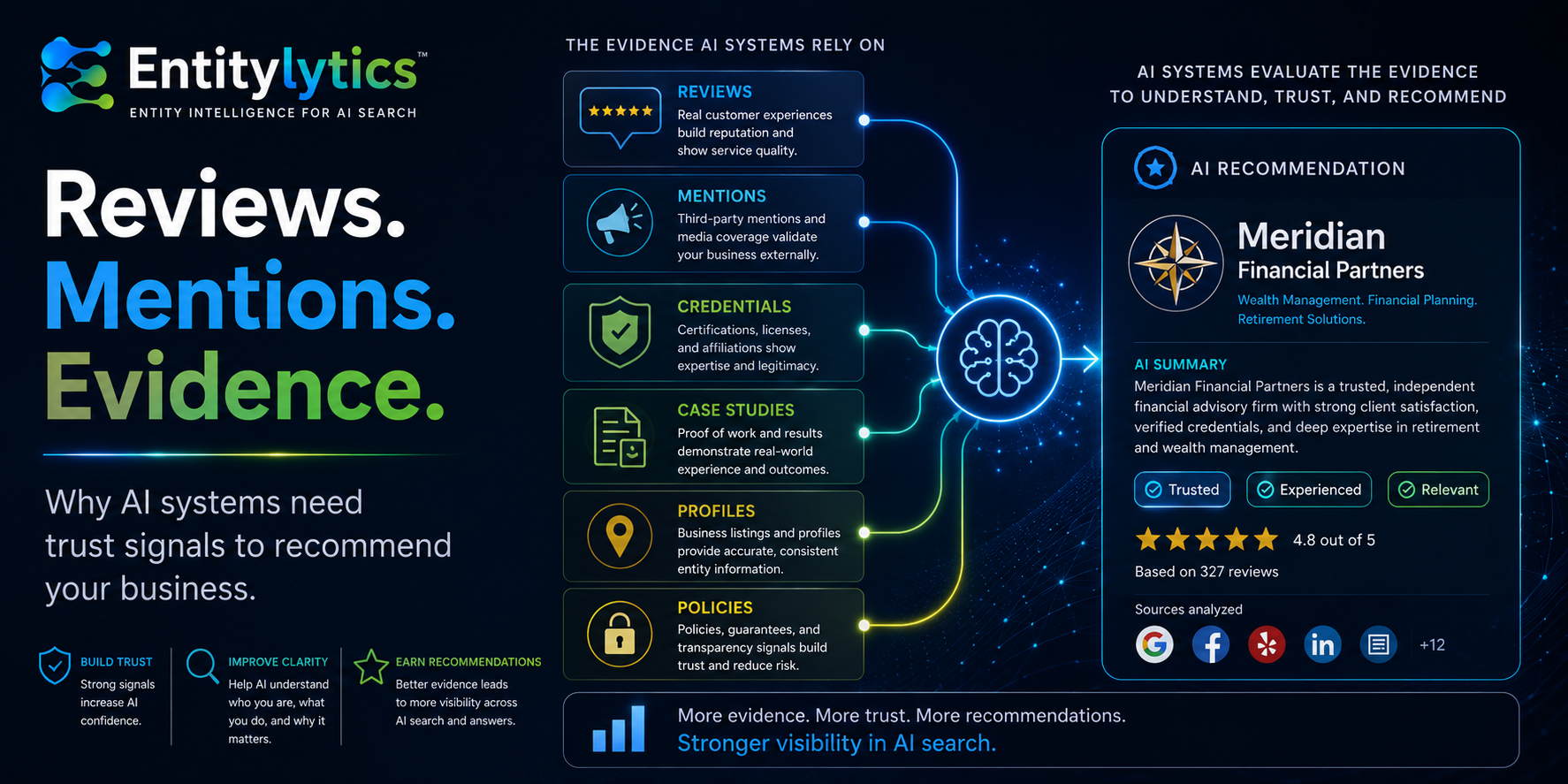
Reviews, credentials, experience, project examples, team information, policies, and third-party validation need to be visible and connected to the business story.
Your public profiles are inconsistent
Conflicting names, categories, descriptions, addresses, service areas, or business details can reduce confidence in how AI systems interpret the entity.
Your website does not connect related evidence
AI systems benefit when service pages, location pages, FAQs, reviews, case examples, and about information reinforce each other through clear structure and internal linking.
Your recommendation fit is not obvious
AI may understand what you sell but not understand when your business should be recommended, what makes it different, or which customer scenarios are the best fit.
The business risk of being unclear to AI
The risk is not only that AI systems may fail to mention your business. They may also misunderstand it, classify it too broadly, miss important strengths, or recommend competitors with clearer evidence.
Omission
Your business may be left out of AI-generated answers even when it is relevant to the customer’s need.
Misclassification
AI may place your business in the wrong category or fail to recognize important services, products, or specialties.
Weak recommendation confidence
AI may hesitate to recommend your business if the evidence around trust, expertise, or fit is incomplete.
Competitor advantage
A competitor with clearer content, stronger trust signals, and better entity consistency may be easier for AI to recommend.
The business that is easiest to understand, verify, and connect to the user’s question may have an advantage over a business that is merely visible.
How to make your business clearer to AI
Improving AI clarity does not mean abandoning SEO. It means strengthening the evidence layer around your business so both search engines and AI systems can understand it more accurately.
Make your business identity unmistakable
Clearly state your business name, category, location, service area, primary services, and customer types. Keep that information consistent across your website and public profiles.
Explain services beyond keywords
Each important service or product should explain what it is, who it helps, when it is needed, what problem it solves, and why your business is qualified to provide it.
Improve your trust evidence
Make experience, reviews, credentials, project examples, team background, guarantees, policies, and third-party mentions easier to find and understand.
Connect related pages together
Use internal links and clear page relationships to connect services, locations, FAQs, about content, reviews, case studies, and educational resources.
Clarify who you serve and when you are the right fit
AI systems need to understand your best-fit customer, service boundaries, geographic relevance, use cases, and differentiators.
Check how AI systems describe your business
Reviewing AI-generated summaries can reveal confusion, missing evidence, weak positioning, or trust gaps that traditional SEO reports may not show.
Visibility is the starting point. Clarity is the next layer.
Google visibility still matters. A website that cannot be found, crawled, or indexed has a serious problem. But AI search adds a new layer to the visibility challenge.
The businesses most likely to benefit from AI-driven discovery will be the ones that make their identity, services, audience, evidence, and recommendation fit easy to understand.
That means the goal is not only to rank. It is to be understood.
It is business clarity, trust confidence, and recommendation readiness.
FAQ: Google visibility and AI clarity
Can my website rank on Google but still be unclear to AI?
Yes. A website can rank for certain keywords while still lacking the business context, trust evidence, entity consistency, and recommendation clarity that AI systems need.
Does AI visibility replace SEO?
No. SEO remains important. AI visibility builds on SEO by adding focus areas such as entity understanding, trust signals, evidence quality, and recommendation readiness.
Why would AI misunderstand a legitimate business?
AI systems depend on available public evidence. If that evidence is vague, scattered, inconsistent, thin, or poorly connected, the business may be misunderstood even if it is legitimate and experienced.
What helps AI understand a business better?
Clear service explanations, consistent business information, strong trust signals, reviews, team background, FAQs, structured page relationships, and third-party validation can all improve AI understanding.
How does Entitylytics evaluate this?
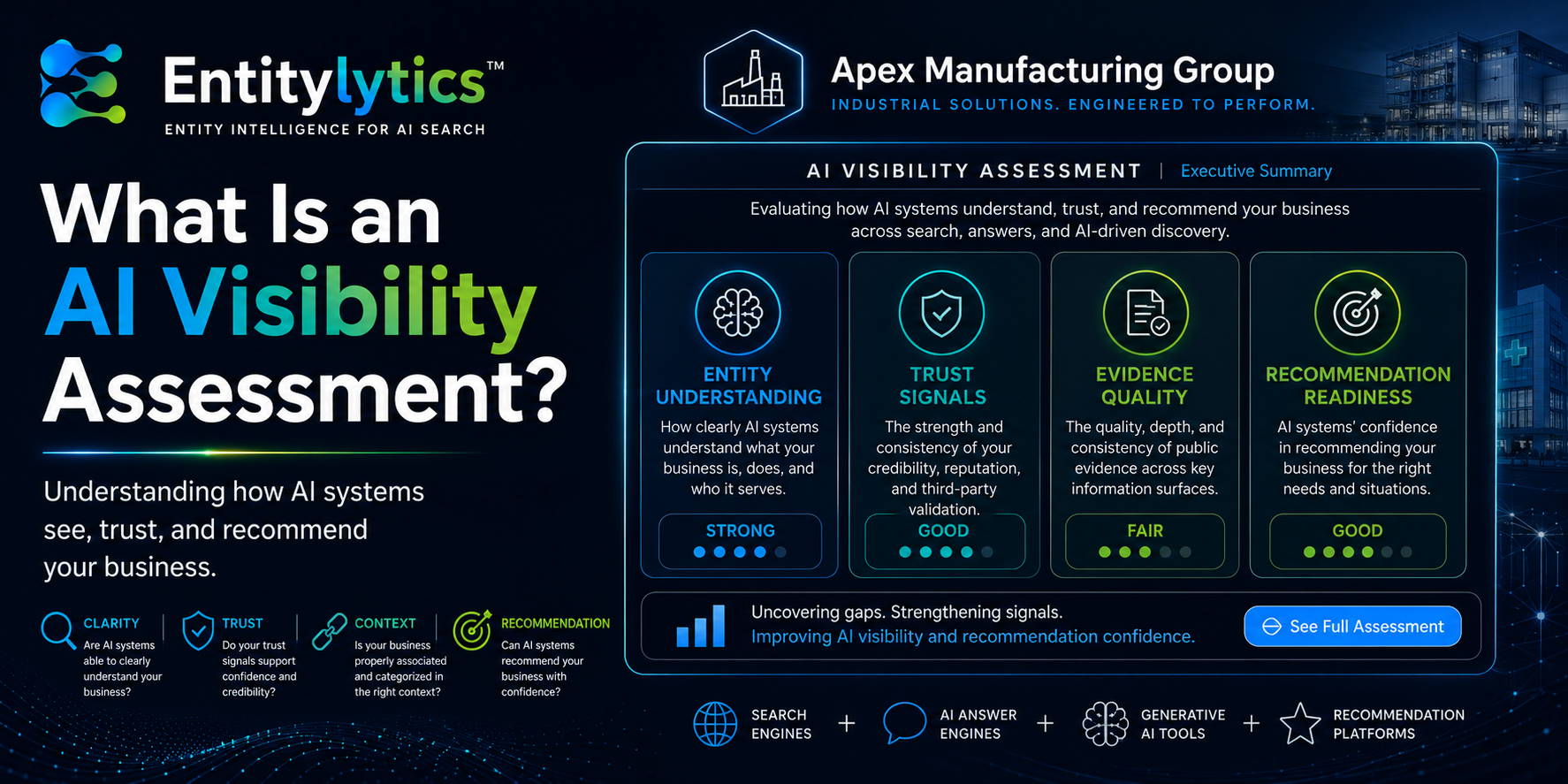
Entitylytics™ evaluates how AI systems may understand, trust, associate, and recommend a business. The assessment identifies clarity gaps, ambiguity, weak evidence, trust limitations, and opportunities to improve AI visibility.
Find out where your business may be unclear to AI
An Entitylytics™ Assessment can help identify where your website and public presence may be visible but not clear enough for AI-driven search and recommendation systems.
Entitylytics™ helps businesses evaluate AI visibility, entity understanding, trust signals, and recommendation readiness.