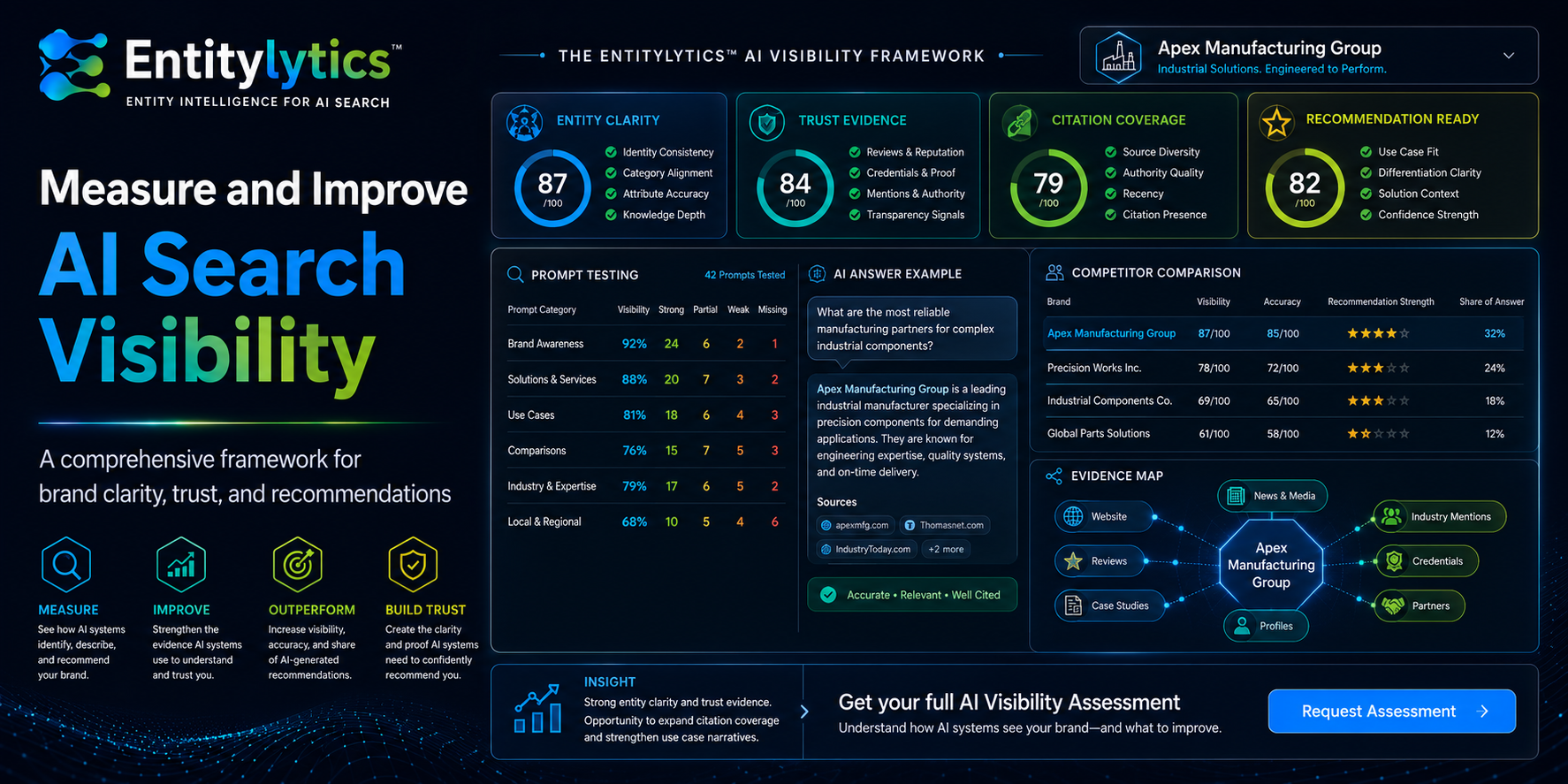
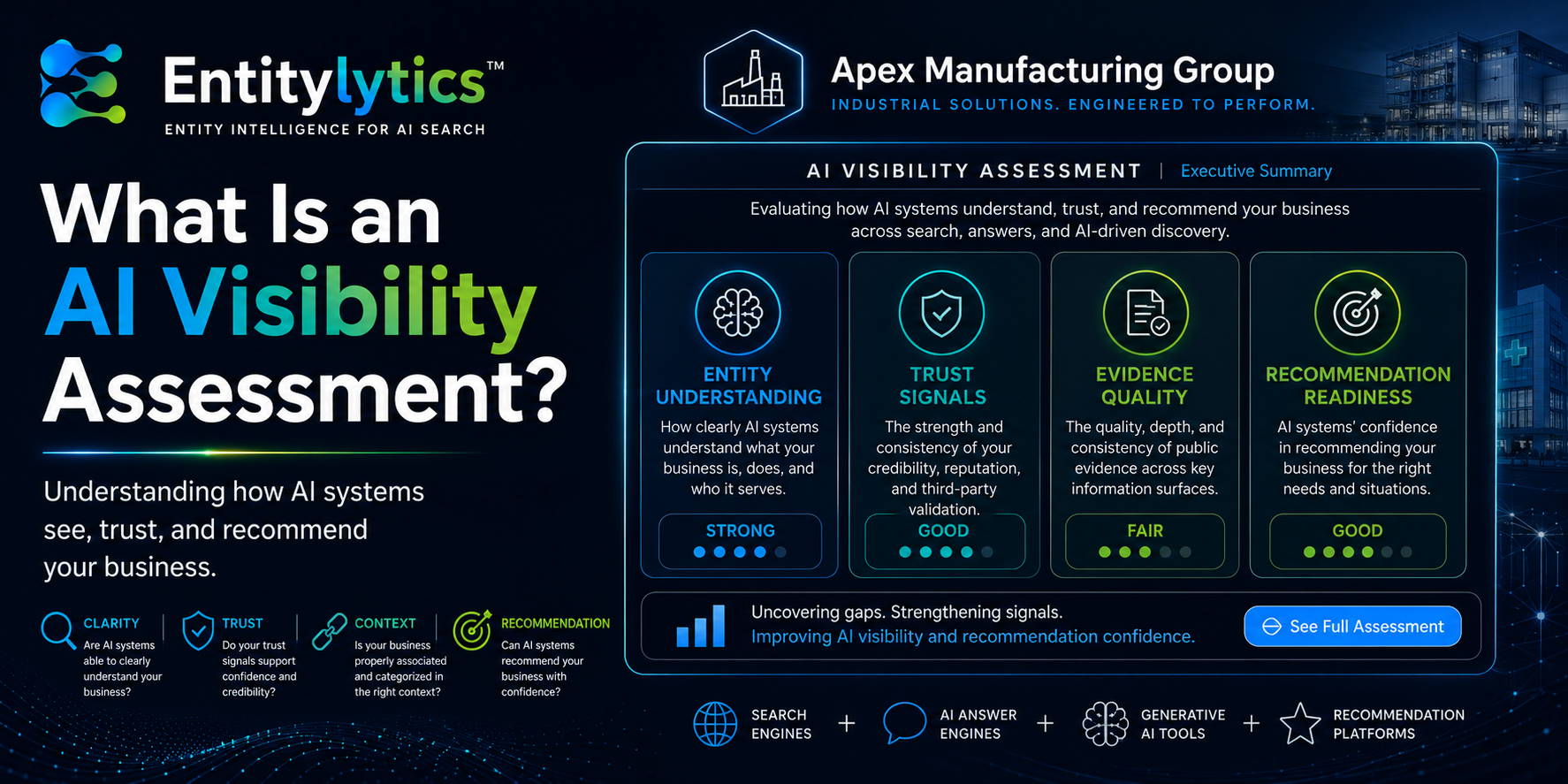
An AI visibility assessment is a structured review of how your business appears to AI systems, answer engines, generative search tools, and recommendation-driven discovery experiences.
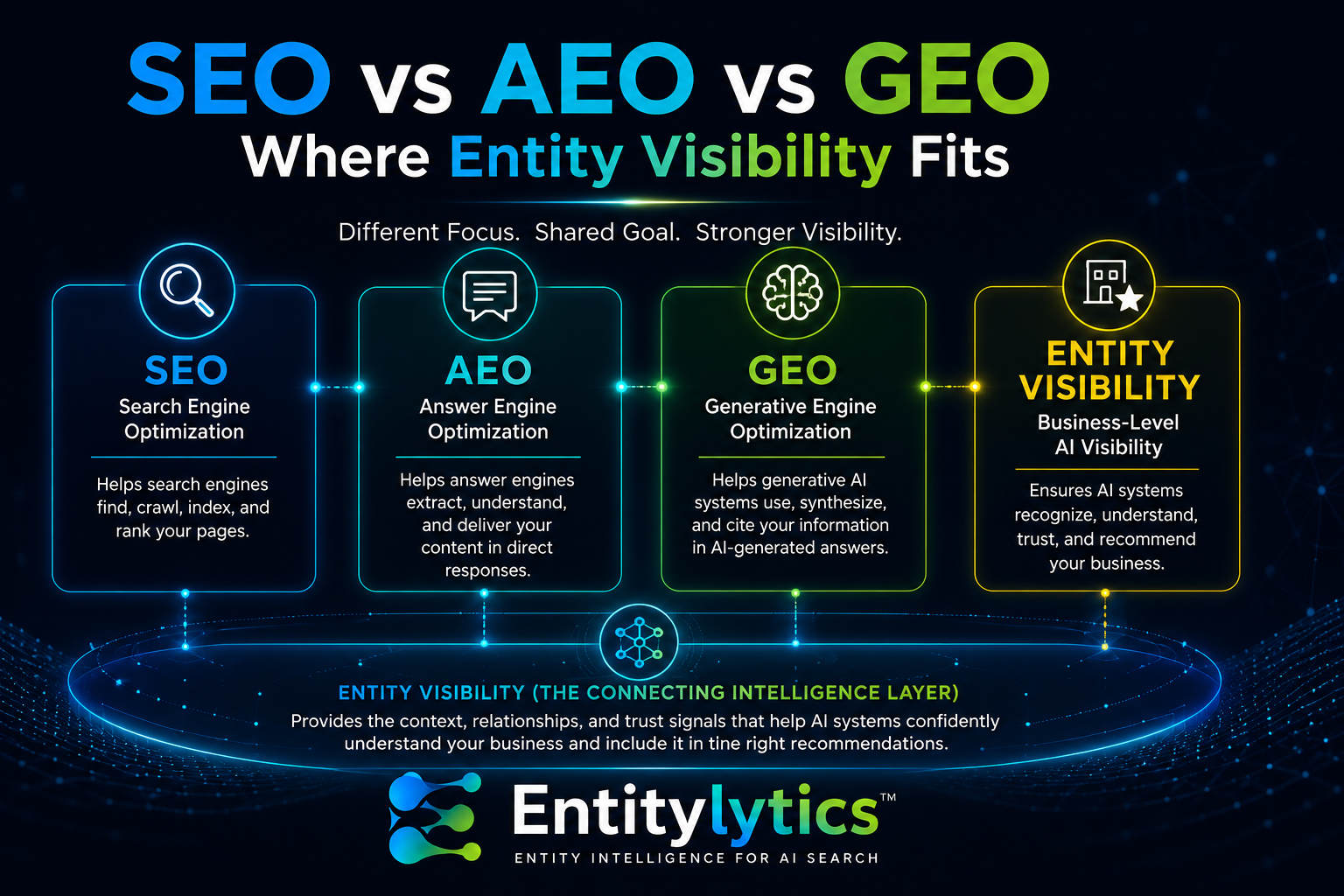
Traditional SEO audits usually focus on whether a website can be crawled, indexed, ranked, and improved for organic search performance. That still matters. But AI visibility introduces a broader question: can AI systems understand the business entity behind the website?
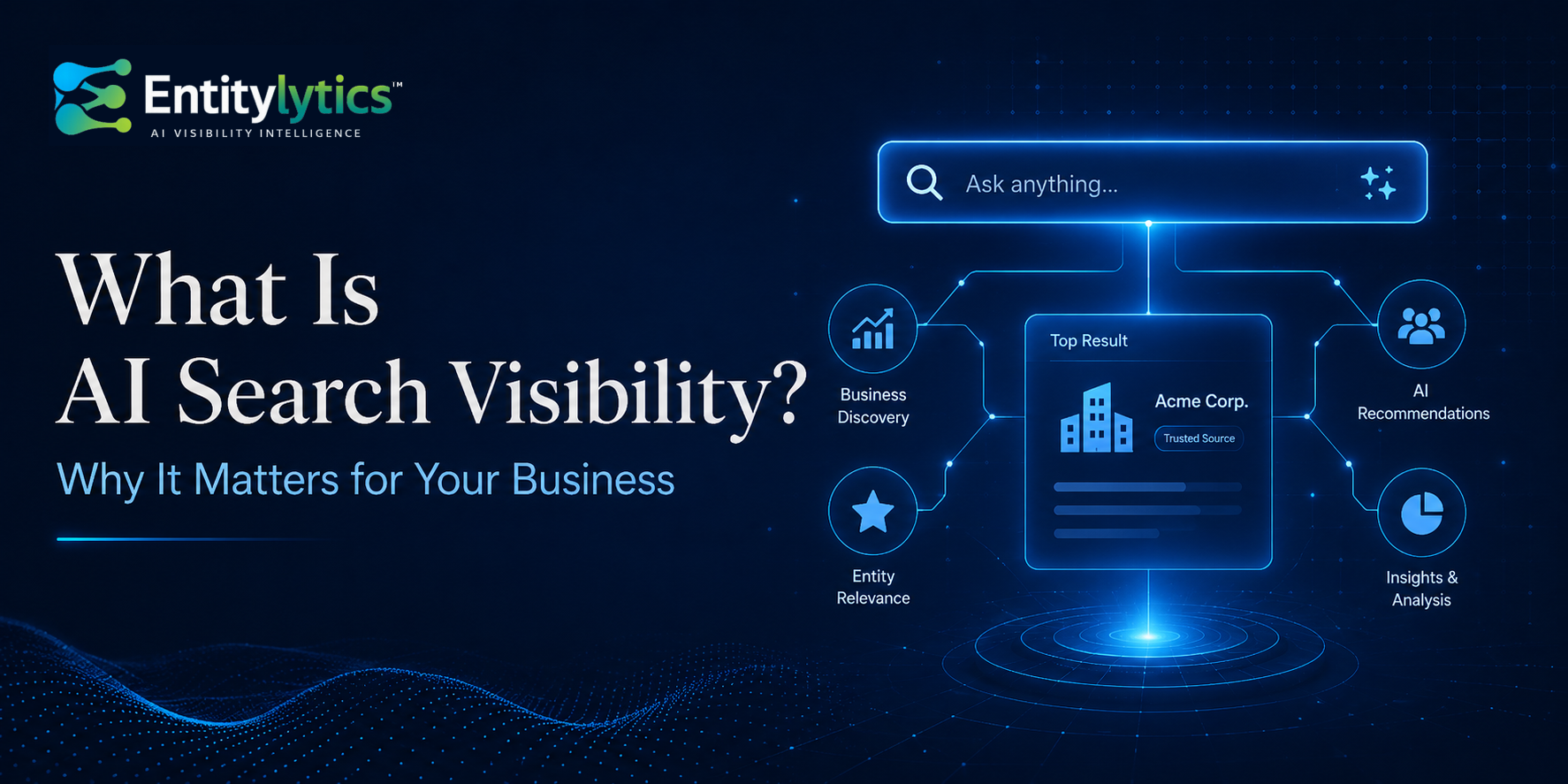
In an AI-assisted search journey, a potential customer may not simply type a keyword and scan a list of links. They may ask an AI system for a recommendation, comparison, explanation, shortlist, or trusted provider. That system then needs to interpret available evidence and decide which businesses are relevant enough, clear enough, and trustworthy enough to include.
It evaluates whether your business is clear, consistent, trusted, and recommendation-ready in the ways AI systems may need to understand it.
Why AI visibility assessments matter
Businesses are used to asking, “Do we rank?” That is still an important question, but it is no longer the only visibility question that matters.
AI systems may summarize a market, recommend a provider, compare options, explain who is best for a certain need, or answer a customer’s question without sending the user through the same traditional search path. In that environment, weak business clarity can become a visibility problem.
Discovery is changing
Customers are increasingly using AI tools to research businesses, compare options, and narrow decisions before reaching out.
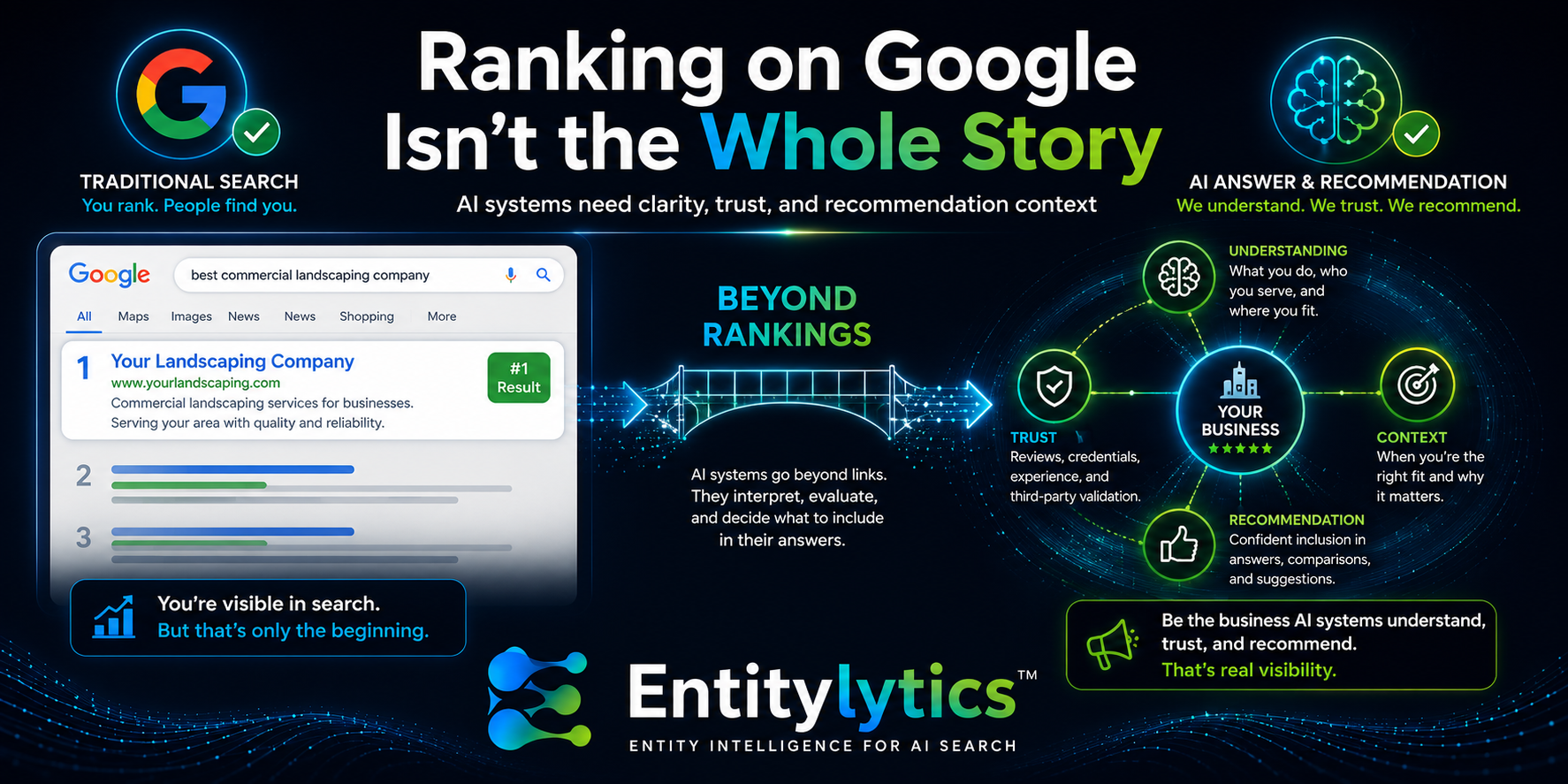
Rankings are not the whole story
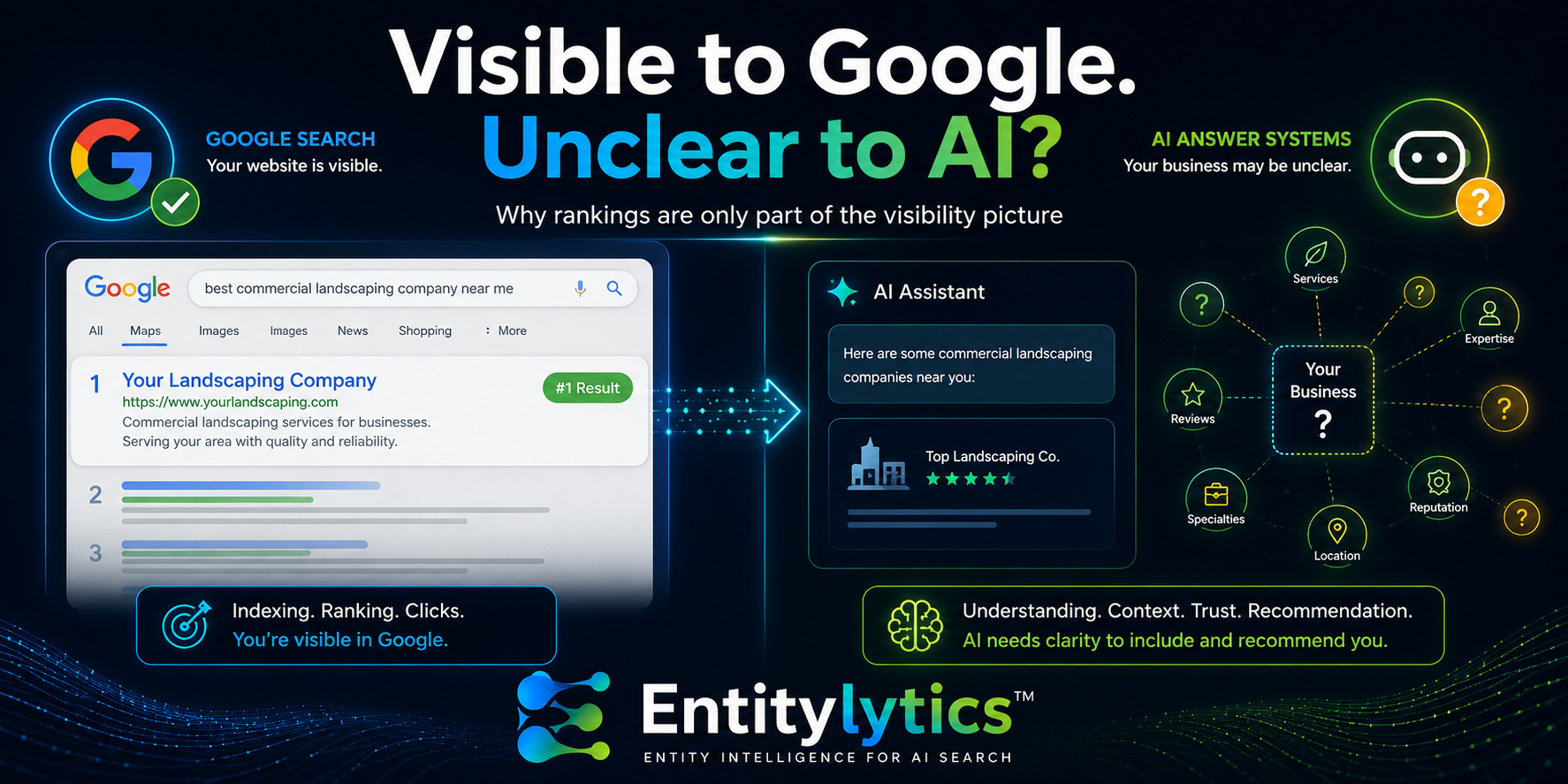
A website may appear in Google but still be unclear to AI systems that need stronger entity, trust, and recommendation context.
Trust signals are becoming more important
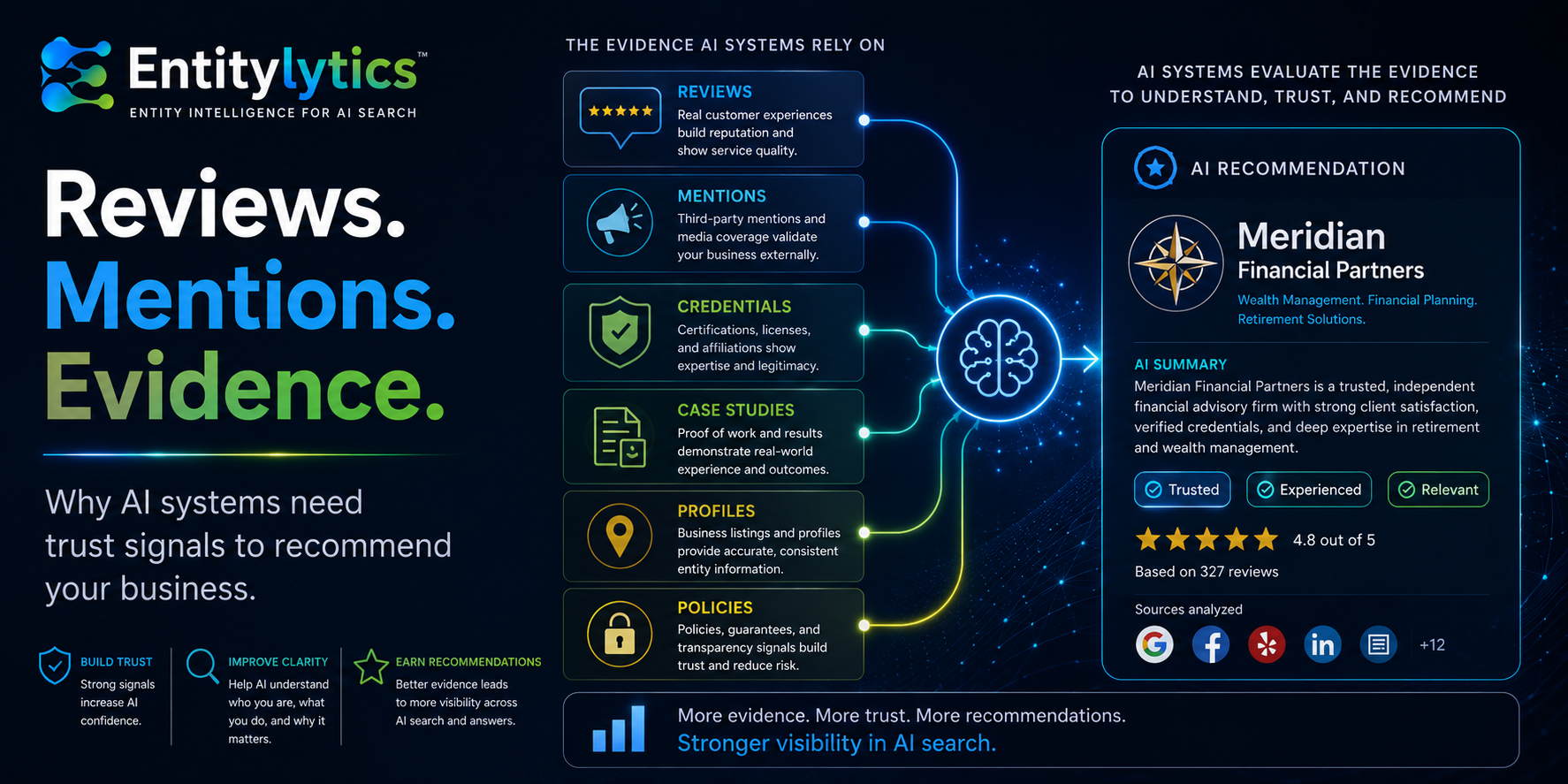
Reviews, credentials, experience, public consistency, policies, and third-party evidence help support recommendation confidence.
Ambiguity can create risk
If AI systems cannot clearly understand your business, they may omit it, misclassify it, or favor competitors with clearer evidence.
What an AI visibility assessment evaluates
A useful AI visibility assessment does not simply ask whether your website has content. It looks at whether the available evidence helps AI systems understand your business accurately and confidently.
Entity recognition
Can AI systems identify your business as a distinct entity and separate it from similarly named companies, locations, products, or unrelated references?
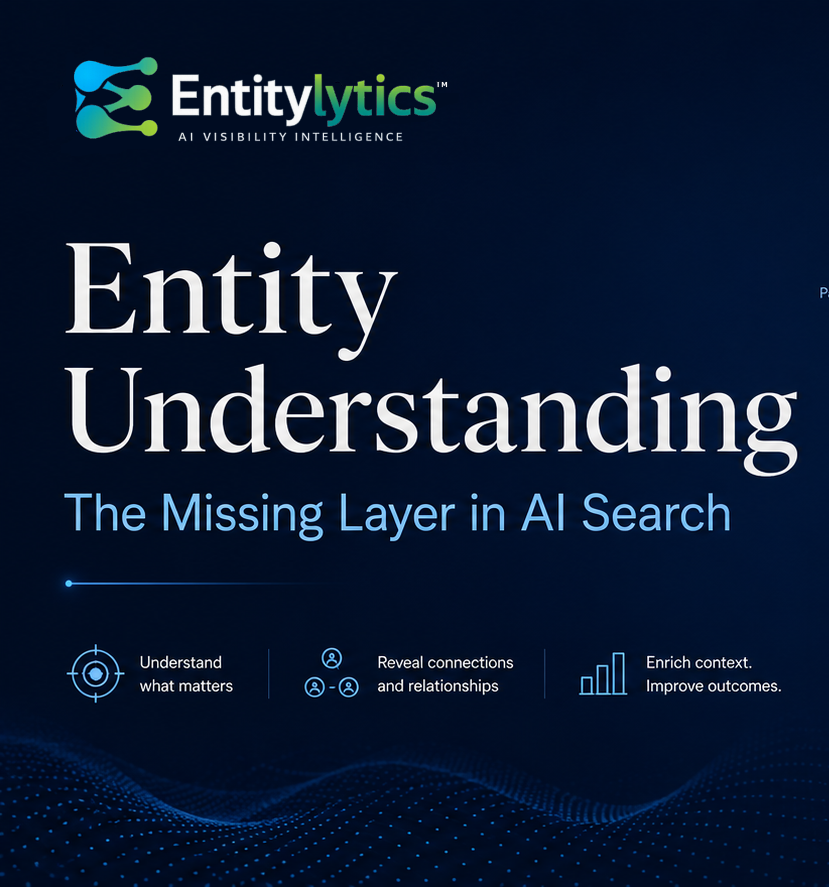
Entity understanding
Can AI systems understand what your business does, who it serves, where it operates, and how its services, products, or expertise fit together?
Trust signal strength
Does your public presence provide enough evidence of credibility, experience, reputation, qualifications, reviews, policies, and legitimacy?
Evidence consistency
Are your website, business profiles, listings, descriptions, categories, locations, and third-party references reinforcing the same identity?
Recommendation readiness
Can AI systems understand when your business should be recommended, who it is best suited for, and what evidence supports that recommendation?
Visibility gaps
Where is your business unclear, under-supported, poorly connected, or vulnerable to being misunderstood by AI-driven discovery systems?
Want to know how AI systems may understand your business?
Entitylytics™ evaluates AI visibility, entity understanding, trust signals, and recommendation readiness so businesses can identify where they are clear — and where AI systems may hesitate.
What an AI visibility assessment is not
Because AI visibility is still a developing area, it is important to be clear about what an assessment should and should not promise.
It is not just an SEO audit
- It does not focus only on rankings or keywords.
- It does not stop at crawlability or metadata.
- It does not treat traffic as the only visibility measure.
- It does not assume page visibility equals AI clarity.
It is a business evidence review
- It looks at how your business is understood.
- It evaluates trust and credibility signals.
- It identifies ambiguity and evidence gaps.
- It focuses on recommendation readiness.
An AI visibility assessment should also not be framed as a guaranteed way to control AI answers. No business can fully control how every AI system responds. The practical goal is to improve the clarity, consistency, and trustworthiness of the public evidence those systems may rely on.
The goal is to make your business easier to understand, verify, and recommend accurately.
Who needs an AI visibility assessment?
AI visibility matters for any business that depends on digital discovery, reputation, search visibility, customer trust, or recommendation-driven buying decisions.
Multi-location businesses
Companies with multiple locations need consistent entity signals, location clarity, category alignment, and strong local trust evidence.
B2B and professional services
Firms that rely on expertise, credibility, and decision-maker trust need clear evidence of qualifications, authority, and business fit.
Healthcare and specialty providers
Practices and provider groups need strong clarity around services, locations, credentials, patient fit, policies, and trust signals.
Manufacturers and suppliers
Product and industrial companies need AI systems to understand categories, applications, specs, buyer use cases, and credibility signals.
Local service businesses
Contractors, clinics, retailers, and service providers need clear service areas, reviews, specialties, and recommendation context.
Agencies and consultants
Agencies can use AI visibility assessments to identify client clarity gaps and prioritize improvements beyond traditional SEO.
How businesses can use the findings
The value of an AI visibility assessment is not just the diagnosis. It is the prioritized action plan that comes from understanding where AI systems may struggle to interpret your business.
Clarify business identity
Findings may show that your business name, category, service area, location structure, or brand positioning needs to be made more consistent across your website and public profiles.
Improve service and product explanations
An assessment may reveal that important services or products are described too briefly, too generically, or without enough context for AI systems to understand customer fit.
Strengthen trust signals
If reviews, credentials, team background, policies, case examples, or third-party mentions are weak or hard to find, those become practical opportunities for improvement.
Connect related evidence
Internal linking, stronger page relationships, clearer FAQs, better about content, and more connected service/location pages can help reinforce the business entity.
Prioritize the gaps that matter most
Not every issue has the same impact. A good assessment helps separate cosmetic improvements from evidence gaps that may affect AI understanding, trust confidence, or recommendation readiness.
That means AI systems have a better chance of understanding who you are, what you do, who you serve, and why your business may be a strong recommendation.
AI visibility is becoming part of business visibility
Businesses are entering a period where search visibility, answer visibility, and recommendation visibility are beginning to overlap. Customers may still use Google, but they may also use AI systems to ask more detailed questions, compare providers, and narrow their options.
That makes AI visibility assessments useful because they look at the business from a different angle. Instead of only asking how a page ranks, they ask how clearly the business is understood.
For companies that care about long-term digital visibility, this is becoming an important layer of strategic review.
FAQ: AI visibility assessments
What is an AI visibility assessment?
An AI visibility assessment evaluates how clearly AI systems may understand, trust, associate, and recommend your business based on public evidence across your website and broader digital presence.
Is an AI visibility assessment the same as an SEO audit?
No. An SEO audit typically focuses on search performance, crawlability, rankings, keywords, content, and technical issues. An AI visibility assessment focuses more heavily on entity understanding, trust signals, evidence clarity, and recommendation readiness.
Can an assessment guarantee AI systems will recommend my business?
No. No assessment can guarantee how every AI system will respond. The goal is to identify and improve the evidence that may help AI systems understand and represent your business more accurately.
What kinds of businesses benefit from this?
Local businesses, multi-location companies, healthcare providers, manufacturers, professional services firms, eCommerce brands, agencies, and B2B companies can all benefit if digital discovery and recommendation visibility matter to them.
How does Entitylytics approach AI visibility assessment?
Entitylytics™ evaluates AI visibility through the lens of entity understanding, trust signals, association clarity, evidence quality, and recommendation readiness. The focus is on identifying practical gaps and prioritized opportunities.
See how clear your business is to AI systems
An Entitylytics™ Assessment can help identify where your business is clear, where evidence may be weak, and where AI systems may need stronger signals to understand and recommend you confidently.
Entitylytics™ helps businesses evaluate AI visibility, entity understanding, trust signals, and recommendation readiness.